Weave first: twill (gabardine), plain weave (canvas) and ripstop
A woven fabric has two sets of yarn: the warp running lengthways and the weft running across. The pattern in which they pass over and under each other is the weave, and it shapes how a fabric behaves on site before weight even enters the picture.
In a plain weave the weft goes over one warp yarn and under the next, all the way across. No other weave ties its yarns together at so many points, so none is tighter. Canvas is a heavy, hard-wearing cloth made this way. Duck is the variety with the yarns packed closer still, and thick cotton duck is a common choice for heavy-duty work clothes. All those interlacings make a plain weave stand stiffer, drape less and shake off creases less readily than a twill.
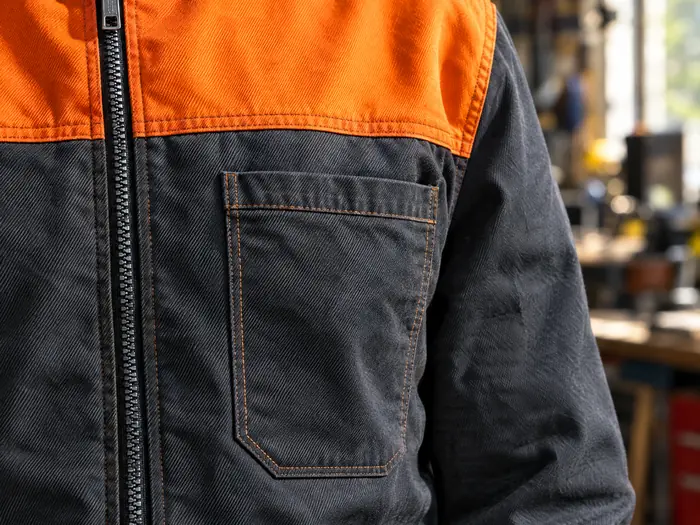
Twill shifts its interlacing one yarn along on every row, and that shift draws the diagonal ribs across the face. Catalogue notation records the build: in a 2/1 twill, read ‘two up, one down’, each warp yarn floats over two weft yarns and dips under one, so the warp dominates the face; 3/1 and 2/2 are the other common builds. Because the yarns are tied down less often than in a plain weave, they have room to move. The cloth drapes more softly and recovers from creasing better, and its ridged surface hides soiling better than a flat one. That is why most work trousers, jackets and coveralls are twill. In English-language catalogues a sturdy cotton twill for uniforms and work clothing is often sold as drill.
Gabardine is the tightly woven member of the twill family. It has far more warp ends than weft picks, a crisp diagonal on the face and a smoother back. The original gabardine was wool; workwear gabardine today is cotton, polyester or a blend of the two. When a workwear supplier says gabardine, they usually mean a dense polycotton or cotton twill, not suiting wool. The tight construction makes it water-repellent, but it is not waterproof.
You can usually spot ripstop by the fine square grid on its surface. During weaving, a stronger and often thicker reinforcing yarn is laid in, typically every 5 to 8 millimetres. When a nail or a sheet-metal edge punctures the cloth, the tear runs into the next reinforcing yarn and stops there instead of running from hem to knee. Not every grid is ripstop, though: in antistatic fabrics the conductive yarn draws a similar check pattern a few millimetres apart. The technical data sheet tells you which one you are looking at.
Fabric types compared, by garment and job
Trousers and coveralls work a fabric hardest: knees, seat and pocket mouths rub every day. Shirts and aprons need to launder well and stay comfortable, while jackets and mid-layers are judged on wind and rain. The table puts eight fabrics you will commonly meet on site side by side, using the same criteria for each.
A note on fleece: names such as 100, 200 and 300 are the weight itself. A 300 fleece weighs roughly 300 grams per square metre and is noticeably warmer than a 100. Softshell is judged less by weight than by construction: ask how the outer face handles wind and water, and whether the inner face is a fleece or a wicking layer.
| Fabric | Construction | Strength | Weakness | Typical use |
|---|---|---|---|---|
| Gabardine / twill | Dense twill with diagonal ribs (2/1, 3/1, 2/2) | Resists abrasion, hides dirt, recovers from creasing | Repels water but is not waterproof | Trousers, jackets, coveralls, uniforms |
| Canvas / duck | Dense plain weave, mostly cotton | Thick, hard-wearing outer face | Stands stiff, drapes less than twill, slow to soften | Heavy work trousers, jackets and outerwear |
| Ripstop | Reinforcing yarns woven in at 5–8 mm intervals | Stops small tears spreading, gives strength at a light weight | Not waterproof; a thin one wears through sooner than heavy cloth | Summer trousers, field jackets, uniforms |
| Polyester-cotton (65/35, 50/50) | Mostly twill, plain or ripstop | Low shrinkage, low creasing, copes with industrial laundering | Absorbs less sweat as polyester rises; polyester melts above 250 °C | Most general-purpose workwear |
| 100% cotton | Twill, plain weave or canvas | Absorbs sweat, soft handle | Shrinks noticeably unless pre-shrunk, creases easily | Hot environments, sweaty work, canvas workwear |
| Stretch (elastic fibre or mechanical) | Added elastic fibre (elastane, elastolefin, elastomultiester), or stretch built into the yarn and weave | Freedom of movement when kneeling and reaching | Elastic fibre must suit the laundering method; very light stretch cloth thins fast | Assembly, installation, kneeling work |
| Softshell | Woven outer face, often backed with fleece or a wicking layer | Blocks wind, sheds light rain, stretches | Not waterproof, tears more easily on sharp edges | Mid or outer layer, site-to-office roles |
| Fleece | Napped polyester knit | Light and warm, holds very little water, dries fast | Lets wind through; low grades pill | Mid-layer under a jacket, indoor warehouses |
Fabric weight (g/m²): light, medium and heavy ranges
Fabric weight, often written GSM, is the mass of one square metre in grams. Labs measure it on small specimens following EN 12127. Where a catalogue quotes ounces, 1 oz/yd² is about 33.9 g/m²: 8 oz comes to roughly 271, 10 oz to 339 and 12 oz to 407 g/m².
Because cloth is sold by the running metre, some quotes give weight per running metre instead. Keep the two apart. A running metre of 150 cm-wide fabric is 1.5 m², so a cloth weighing 360 grams per running metre is 240 g/m².
No standard defines light, medium or heavy. The ranges below come from the current catalogues of two European workwear fabric mills. One lists its workwear range at 180–360 g/m² and its polycotton range at 150–300 g/m². The other’s workwear fabrics run from 110 to 315 g/m², with most of its 65/35 twills grouped between 170 and 260 g/m².
Weight on its own does not tell you how strong a fabric is. A twill and a plain weave of the same weight tear and abrade differently, and yarn twist and fibre blend shift the result again. Tensile, tear and abrasion reports show strength. On most sites a winter set lasts longer if you add a layer rather than a heavier cloth, and a summer set does better with vents across the back and under the arms than with a fabric dropped below the light range.
| Class | Typical range | Typical garment | Typical setting |
|---|---|---|---|
| Light | About 150–200 g/m² | Work shirts, summer trousers and jackets, aprons, service and healthcare uniforms | Laboratories, kitchens, food lines, shops |
| Medium | About 200–270 g/m² | General-purpose work trousers, jackets, coveralls | Assembly lines, warehousing and distribution, maintenance workshops |
| Heavy | About 270–360 g/m² | Winter trousers and coveralls, heavy work jackets | Construction, mining, heavy industry, outdoor maintenance |
Blend ratio: sweat, shrinkage, creasing and fading
The workhorse blend for industrially laundered workwear is 65% polyester, 35% cotton. The same catalogues list 50/50 and cotton-rich blends of 60% cotton or more as the comfort-leaning options. Shift the ratio and four things move with it.
On sweat, cotton decides. It absorbs moisture, while polyester takes up very little water and dries quickly. As the polyester share rises, sweat stays against the skin rather than moving into the cloth, and in hot, humid weather that feels stifling. A kitchen crew at the stove or a team on a summer building site will be more comfortable in a cotton-rich blend or 50/50. On an air-conditioned assembly line, 65/35 rarely gives anyone trouble.
Shrinkage reverses the picture. Pure cotton can shrink noticeably in the wash, which is why cotton workwear fabrics are usually pre-shrunk at the mill, and adding polyester cuts shrinkage further. It is measured under EN ISO 5077: the specimen is marked, put through a set wash-and-dry cycle, measured again, and the change in length and width is reported as a percentage.
Polyester wins on creasing too. For a uniform that has to look pressed at nine and still look it at five, buyers pick 65/35 or 50/50 with a crease-resist finish.
Fading has two sources, washing and light. Colour fastness is measured to washing under EN ISO 105-C06, to perspiration under EN ISO 105-E04, to rubbing under EN ISO 105-X12 and to light under EN ISO 105-B02. Fluorescent hi-vis colours fade markedly in sunlight, so even in storage those garments should be kept out of direct sun.
There is one hard limit. Polyester melts above roughly 250 °C. Where there is weld spatter, grinding sparks or open flame, a polyester-rich fabric holes, and molten fibre can stick to skin. Adjusting the blend is no answer to that risk; the move is to fabric certified to EN ISO 11611 (welding) or EN ISO 11612 (heat and flame).
Stretch comes from one of two places. The first is an added elastic fibre. Elastane is the best known: it can extend to several times its length and spring back, and it usually makes up only a few per cent of the cloth. Catalogues of fabric meant for industrial laundries also show two alternatives: elastolefin, known for its heat and chemical resistance, and bicomponent polyester (elastomultiester). In one mill’s range elastolefin runs at 3–4.5% and elastomultiester at 20–32%. The second route is mechanical stretch, where the give comes from the yarn and weave rather than an added fibre. Whichever route you take, a stretch fabric whose weight has been pared right down for flexibility thins quickly at the knee.
Industrial laundering: EN ISO 15797 and the symbols on the label
If your workwear goes out on a rental contract or to an industrial laundry, the fabric faces far tougher treatment than a domestic wash. The lab equivalent of a home wash is EN ISO 6330; for industrial laundering it is EN ISO 15797.
ISO 15797 sets out eight washing procedures and two drying procedures: tumble drying, and tunnel or cabinet finishing. Nobody runs all of them. The lab picks the ones that suit the fabric’s composition and end use, then assesses dimensional change, colour, creasing, seam puckering and pilling. The standard does not tell launderers how to wash. It simulates their process on intermediate-scale machines, and it says itself that trials on the real laundry line are sometimes advisable before a final decision.
The 2017 edition brought two changes worth knowing. The scope no longer stops at cotton, polyester and their blends, and it now takes in some PPE garments. In the tables, the headings ‘cotton’ and ‘polyester/cotton’ became ‘full load’ and ‘reduced load’, so fibres other than cotton and polyester can be tested with the same procedures.
EN ISO 30023 puts the outcome on the label. Its symbols show whether a garment is suitable for industrial laundering to ISO 15797, separately for washing, bleaching, tunnel finishing and tumble drying, and they are drawn to look clearly different from the EN ISO 3758 symbols on a domestic care label. Protective garments may also state how many washes the protection survives; on a sample hi-vis label this appears as ‘max. 50x’.
The arithmetic is simple. Trousers washed twice a week go through about a hundred cycles a year. Ask the fabric supplier how many cycles their shrinkage and colour reports cover, using your laundering method. A data sheet that just says ‘wash-resistant’ does not answer that.
Let's choose the right product for your team
Tell us the site conditions, quantity and the standard you need; we come back with fabric, model and sample options.
Reinforcement zones and seams
Even with the right fabric, work trousers usually give way first at the knee, the seat and the pocket mouth. These areas are strengthened with reinforcement and stitching rather than a change of cloth. Stitch types are numbered and classified in ISO 4915, so a specification can name the stitch type and a seam breaking force measured to EN ISO 13935-2 instead of asking for ‘strong seams’.
If the reinforcing fabric shrinks differently from the main cloth, the knee panel puckers or ripples after the first wash. That is why both fabrics should have been tested under the same laundering method; even a few millimetres of difference shows on a row of trousers.
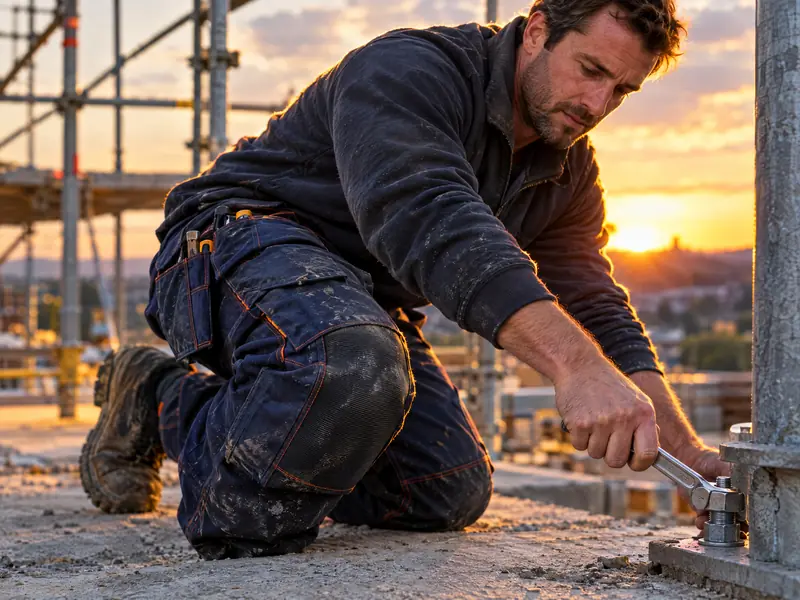
- Knees: a double layer of cloth or a high-tenacity polyamide reinforcement panel. Where knee pads are used, a pocket is built into the reinforcement.
- Pocket mouths, belt loops and the base of the fly: bar tacks, short reinforcing bars of dense zigzag stitching. Pockets that carry heavy tools get a double layer at the bottom.
- Main seams: felled seams. One edge is folded inside the other and stitched down flat, so the raw edges are enclosed and cannot fray.
- Side seams: a two-needle, five-thread safety stitch, which sews a chain stitch and an overlock side by side in one pass, so the seam is joined and its edge finished at the same time.
EN ISO 13688: general requirements for protective clothing
The line between ordinary workwear and protective clothing is drawn in law. Turkey’s regulation on the use of PPE at work (Official Gazette, 2 July 2013, No. 28695), drafted in parallel with EU Directive 89/656/EEC, excludes, in Article 2, ordinary working clothes and uniforms that are not specifically designed to protect the worker’s health and safety. Trousers that make no protective claim do not need to meet a PPE standard. Once a garment claims hi-vis, flame, welding, antistatic or rain protection it is PPE, and the risk assessment decides which protection is needed.
For that second group, EN ISO 13688 is always in play. It holds the baseline every protective garment has to meet: it must not harm the wearer, it must be ergonomic, carry a proper size designation, cope with ageing through use and washing, work alongside other PPE, be marked correctly and come with the manufacturer’s information. It is never used on its own. The protective claim rests on a specific standard such as EN ISO 20471 (high visibility), EN ISO 11612 (heat and flame), EN 1149-5 (antistatic) or EN 14058 (cool environments), and 13688 is the base it sits on.
Behind the innocuousness requirements sit concrete tests: pH of the fabric’s aqueous extract, chromium(VI) in leather parts, nickel release from metal trims that touch the skin, and amines that azo dyes can release. On ageing, dimensional change after washing and drying is measured to EN ISO 5077, and industrial laundering symbols follow EN ISO 30023. Size is given on the label as a designation based on body measurements.
The standard replaced EN 340 in 2013 and gained its A1 amendment in 2021. The amendment tied body measurement definitions to ISO 8559-1 and ISO 8559-2, redrafted the rules on pictograms, and added pictograms for date of manufacture, use-by date and protection against the thermal effect of an electric arc. Commission Implementing Decision (EU) 2023/941 lists EN ISO 13688:2013 together with its A1:2021 amendment as a harmonised standard; the unamended 2013 text dropped off that list on 9 June 2024. TSE, Turkey’s standards body, is a CEN member, so the standard is published there as TS EN ISO 13688.
Questions to ask before choosing a fabric
A few questions put to the site before anyone opens a catalogue usually cut the field to two or three fabrics. Three examples: a construction crew on structural work might take a polycotton twill or canvas above 270 g/m², with polyamide knee reinforcement and a separate ripstop set for summer. An automotive assembly line might run a medium-weight 65/35 twill, with ESD fabric carrying a conductive grid in the electronics area, working together with grounded footwear and flooring (EN IEC 61340-5-1). A warehouse might pair medium-weight trousers with fleece and softshell layers on top, with a hi-vis class set separately for staff on the loading dock.
- Does the job need a protective claim? If the risk assessment calls for hi-vis, flame, welding, antistatic or rain protection, the choice starts from certified PPE fabric.
- How will the garments be washed? At home, in an in-house laundry or by a rental company. For industrial laundering, look for polycotton tested to ISO 15797.
- How hot is the workplace, and how hard does the work make people sweat? In hot, active jobs cotton content and ventilation come first; in air-conditioned interiors, crease resistance does.
- How much load do knees and pockets take? Crews who kneel need medium or heavy twill, knee reinforcement and stretch considered together.
- What kind of dirt? Oil and grease call for dark shades and a soil-release finish; on a food line light shades are chosen so that dirt shows.
- How long should the garments last? If a purchase is meant to last two years at a hundred washes a year, judge the fabric on at least two hundred cycles.
What to put in the specification when you order
Ask three suppliers for ‘navy gabardine, good quality’ and you will get three different fabrics, with no fair way to compare the quotes. The lines below put every offer on the same footing. When you request test reports, ask for after-wash values as well, since a garment spends its life at wash fifty or a hundred, not on day one.
When you ask Formasan for a quote, you do not need the whole list. Telling us where the garments will be worn, how they will be washed, how many you need and whether any protection is required is enough to discuss fabric options over samples. Having a sample worn on site for a week before bulk production is the cheapest way to avoid paying for the wrong cloth.
- Fibre blend in percentages (for example 65% polyester, 35% cotton), plus the type and share of any elastic fibre.
- Weave: 2/1 twill, 3/1 twill, plain weave, ripstop.
- Weight in g/m² and the tolerance you will accept.
- Colour: corporate colour reference and an approved lab dip or swatch.
- Finishes: water-repellent, soil-release, crease-resist, pre-shrunk.
- Laundering method: domestic (EN ISO 6330) or industrial (EN ISO 15797), and the expected number of cycles.
- Make-up: reinforcement zones, stitch types, bar tack positions, size chart and size breakdown.
- For protective garments, the relevant standard together with EN ISO 13688.
| Property | Standard | What it shows |
|---|---|---|
| Weight | EN 12127 | Mass per square metre, from small specimens |
| Tensile strength | EN ISO 13934-1 | Maximum force and elongation at that force, strip method |
| Tear strength | EN ISO 13937-2 | Force needed to propagate a tear in a trouser-shaped specimen |
| Abrasion | EN ISO 12947-2 | Number of rubs on a Martindale tester before the specimen breaks down |
| Pilling | EN ISO 12945-2 | Pills and fuzz on the surface after rubbing |
| Dimensional change (shrinkage) | EN ISO 5077 | Change in length and width after washing and drying, as a percentage |
| Laundering method | EN ISO 6330 / EN ISO 15797 | Lab equivalent of domestic or industrial laundering |
| Colour fastness | EN ISO 105-C06, -E04, -X12, -B02 | Colour change and staining from washing, perspiration, rubbing and light |
| Seam strength | EN ISO 13935-2 | Maximum force at which the seam ruptures (grab method) |
Standards and regulations referenced
- EN ISO 13688:2013+A1:2021
- EN ISO 15797:2018 (ISO 15797:2017)
- EN ISO 30023:2021
- EN ISO 6330:2021
- EN ISO 5077:2008 (ISO 5077:2007)
- EN 12127:1997
- EN ISO 13934-1:2013
- EN ISO 13937-2:2000
- EN ISO 12947-2:2016
- EN ISO 12945-2:2020
- EN ISO 13935-2
- EN ISO 105-C06:2010
- EN ISO 105-E04:2013
- EN ISO 105-X12:2016
- EN ISO 105-B02:2014
- EN ISO 3758:2023
- ISO 4915:1991
- ISO 8559-1
- ISO 8559-2
- EN ISO 11611:2015
- EN ISO 11612:2015
- EN 1149-5:2018
- EN IEC 61340-5-1:2024
- EN 14058:2017+A1:2023
- EN ISO 20471:2013+A1:2016
- EN 343:2019
- EN ISO 24232:2025
- Regulation (EU) 2016/425
- Council Directive 89/656/EEC
- Commission Implementing Decision (EU) 2023/941
- Kişisel Koruyucu Donanımların İşyerlerinde Kullanılması Hakkında Yönetmelik (RG 02.07.2013, sayı 28695)
- DGUV Information 212-016 Warnkleidung (11/2025)