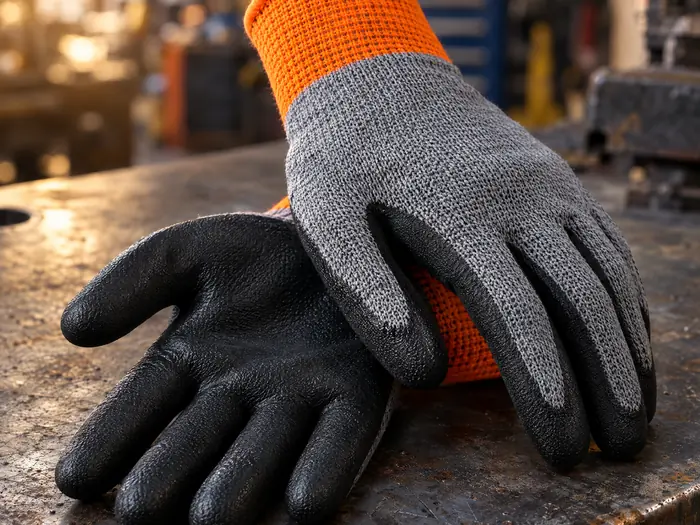

The shield pictogram and the six characters under it
A glove tested to EN 388 carries a shield-shaped pictogram on the glove or on its label. The string underneath always runs in the same order: four digits, then a letter, then a P if impact protection is claimed. If you only see four digits, the glove was most likely tested to the old 2003 edition.
Each character is the outcome of a separate laboratory test. A digit is the level reached in that test, and 0 means the glove was tested but fell short of level 1. X is something else: the test was not carried out, or could not be applied to that glove. The abrasion specimen is cut from the palm, so the first digit describes the surface that wears out first.
| Position | Property | How it is measured | Shown as |
|---|---|---|---|
| 1 | Abrasion | Martindale machine with 180-grit abrasive paper; rubs until the specimen wears through | 0–4 or X |
| 2 | Cut (coup) | Circular blade moving back and forth under 5 N, up to 60 cycles; result is an index against a reference fabric | 0–5 or X |
| 3 | Tear | Force needed to tear a trouser-leg specimen (N) | 0–4 or X |
| 4 | Puncture | Force needed for a standard probe to pierce the specimen (N) | 0–4 or X |
| 5 | Cut (ISO 13997) | Straight blade, a new one for every cut; force that cuts through over a 20 mm stroke (N) | A–F or X |
| 6 | Impact | EN 13594 method; 5 J impact on the knuckle area | P or blank |
What each level actually requires
Every level is a floor, not a measurement. A glove rated 3 for abrasion survived at least 2,000 rubs; it might have lasted 7,900 and it would still be a 3. When two gloves share a digit and the difference matters to you, ask for the test report and compare the measured values.
The coup figures have no unit. The blade cuts a reference canvas, then the glove specimen, then the canvas again, and the index sets the cycles needed for the specimen against the canvas average. The higher it is, the longer the glove held out relative to the reference. Tear and puncture are measured directly in newtons.
Impact has no levels: position six is either P or empty. The method is borrowed from EN 13594, the motorcycle glove standard. A 2.5 kg striker delivers 5 J to the knuckle area, and four gloves are each struck once on a different knuckle. The glove earns its P if the transmitted force averages no more than 7 kN and no single result goes above 9 kN.
| Level | Abrasion (rubs) | Coup cut (index) | Tear (N) | Puncture (N) |
|---|---|---|---|---|
| 1 | 100 | 1.2 | 10 | 20 |
| 2 | 500 | 2.5 | 25 | 60 |
| 3 | 2,000 | 5.0 | 50 | 100 |
| 4 | 8,000 | 10.0 | 75 | 150 |
| 5 | — | 20.0 | — | — |
Cut levels A to F under ISO 13997
The letter in fifth position comes from the ISO 13997 method, run on an instrument known as a tomodynamometer, or TDM. A straight blade is drawn across the specimen under a set load and the distance it travels before cutting through is recorded. Because the blade is replaced after every cut, blunting cannot flatter the result. Cuts at several loads give a trend line, and the reported figure is the force needed to cut through the material over a 20 mm stroke.
Newtons mean little on a shop floor, so a rough conversion helps. Cutting through an F-rated material within a 20 mm stroke takes roughly 3 kg of weight bearing on the blade. Treat that as a laboratory comparison, though: in a real incident the angle, speed and sharpness of the edge all change. The letter ranks gloves against each other. It does not promise that a cut will not happen.
| Level | Minimum force (N) | Approximate mass equivalent |
|---|---|---|
| A | 2 | 0.2 kg |
| B | 5 | 0.5 kg |
| C | 10 | 1.0 kg |
| D | 15 | 1.5 kg |
| E | 22 | 2.2 kg |
| F | 30 | 3.1 kg |
Why there are two cut tests, and which one to trust
Under EN 388:2003 cut resistance was measured by the coup test alone, and its weak spot was well known. Yarns with hard fibres such as steel wire or glass fibre dulled the circular blade, a dull blade needed more cycles, and the glove came out looking tougher than it was. The 2016 edition put a number on the problem. The reference fabric is cut before and after the glove specimen; if the cycle count rises by a factor of more than three, the blade is deemed blunted. The cut rating then comes from ISO 13997 and the coup position shows X.
When a glove carries both results, the instructions must state that the circular blade result is indicative only and the straight blade result is the reference. So read the letter. The standard itself says there is no correlation between the two methods, which is why a glove showing coup 5 and only C under ISO 13997 is not contradicting itself. Labels like that do turn up on the market.
Imported catalogues add a third scale. ANSI/ISEA 105, used in the United States, runs from A1 to A9 and reports force in grams. A3 means at least 1,000 grams and is not the same thing as EN 388 level A or coup 3. If a listing promises "cut level 6", it is most likely quoting the ANSI scale, because EN 388 has no sixth cut level.
Sample codes decoded: 4X43D, 4X43DP, 4542C, 3121X
4X43D is a typical profile for a cut-resistant knitted glove. The X in second place is not a gap in the paperwork; most likely the yarn blunted the coup blade and the cut rating was set by ISO 13997 instead. Position six is empty, so there is no impact claim. Add a P and you have 4X43DP: the same mechanical figures on a glove with back-of-hand protection that passed the impact test.
4542C shows both cut results side by side, coup 5 and ISO 13997 C. C is the one to use. The figure worth a second look is puncture, where a 2 means a glove that looks strong on cut is only middling against penetrating objects.
3121X reads like a light general-purpose glove for dry assembly, packing or warehouse handling. Abrasion is reasonable, cut resistance is minimal and the ISO 13997 test was not run. It does not belong anywhere near a sharp edge.
There are two things no code will tell you. Gloves with a tear level of 1 or more must carry a warning not to be worn where they could be caught by moving machine parts, so a glove at a drill, a lathe or a rotating shaft is a hazard of its own. And the puncture digit says nothing about needles: the test uses a 4.5 mm probe, far thicker than a needle, and the standard itself states that limit.
| Code | Abrasion | Coup cut | Tear | Puncture | ISO 13997 cut | Impact |
|---|---|---|---|---|---|---|
| 4X43D | 4 (8,000 rubs) | X | 4 (75 N) | 3 (100 N) | D (15 N) | — |
| 4X43DP | 4 (8,000 rubs) | X | 4 (75 N) | 3 (100 N) | D (15 N) | P |
| 4542C | 4 (8,000 rubs) | 5 (index 20.0) | 4 (75 N) | 2 (60 N) | C (10 N) | — |
| 3121X | 3 (2,000 rubs) | 1 (index 1.2) | 2 (25 N) | 1 (20 N) | X | — |
Let's choose the right product for your team
Tell us the site conditions, quantity and the standard you need; we come back with fabric, model and sample options.
Choosing a cut level for the job: sheet metal, glass, assembly
EN 388 does not say which level to wear for which task; that comes from the workplace risk assessment. That is also why a glove enquiry to Formasan goes further when it describes the job, not just the code: what is being handled, how sharp the edges are, whether hands are oily or dry, and whether the glove stays on for the whole shift. With that, different coatings and cuff lengths at the same cut level can be compared side by side.
The scope of ISO 13997 is a useful hint as well. The method was written to measure resistance to sharp edges such as knives, sheet metal parts, swarf, glass, bladed tools and castings. The ranges below are common starting points on site, to be confirmed by trying samples on the actual parts.
- Assembly, packing and dry handling: where cut risk is low, A–B can be enough. Dexterity is the real requirement, because the wearer still has to pick up screws, clips and connectors.
- Sheet metal, profiles and press feeding: burred edges and sliding parts usually call for D or above. Consider a long cuff or a sleeve so the wrist is not left exposed.
- Flat glass: typically E–F. Broken glass can slide towards the wrist and forearm, so cuff length matters as much as the letter.
- For oily metal parts and swarf, a D-level glove with a nitrile coating that grips through oil is a common choice. Anyone clearing swarf by hand should check the puncture digit too.
EN 388:2003 versus the 2016 edition
The old code had four digits: abrasion, cut, tear, puncture. The 2016 edition added two characters, the ISO 13997 letter and P for impact. Less visible changes move results as well. The abrasion test now specifies a particular abrasive paper, and gloves previously tested on a gentler paper can score lower. The coup blade is slightly sharper, so the same material may come out with a lower index. There is also a new cap: the test stops at 60 cycles even if the specimen has not been cut through. The 2003 edition had no such limit.
In practice, a glove rated 4543 under the 2003 edition may not keep those figures when it is retested to the 2016 edition. Where the yarn blunts the blade, the coup digit can become an X and the cut rating moves to the letter. If a purchasing list mixes old and new labels, compare gloves that were tested to the same edition.
The A1 amendment of 2018 corrected the definition of the test fabric, the normative references and some terminology. The way the code is read did not change, so a label citing EN 388:2016 and one citing EN 388:2016+A1:2018 are read the same way.
EN ISO 21420: the baseline every protective glove must meet
EN 388 is never applied on its own. A protective glove first has to meet the general requirements of EN ISO 21420, which replaced EN 420 in 2020 and received an A1 amendment in 2024. It makes no protection claim of its own; it deals with whether the glove is harmless to the skin, properly sized and usable.
Some concrete limits: material pH must fall between 3.5 and 9.5, and chromium VI in leather must stay below 3 mg/kg. Sizes are defined for hands from size 4 to 13. For dexterity, the wearer tries to lift steel pins of different diameters off a flat surface; the thinnest pin they manage three times within 30 seconds sets the grade. For fine assembly work that figure deserves as much attention as the cut level.
For buyers in Turkey there are two further layers. Employer duties are set by the regulation on the use of PPE in workplaces (Kişisel Koruyucu Donanımların İşyerlerinde Kullanılması Hakkında Yönetmelik, Official Gazette 2 July 2013, No. 28695): equipment is chosen on the basis of the risk assessment and must carry CE marking and instructions in Turkish. Placing PPE on the market falls under the Turkish PPE Regulation aligned with Regulation (EU) 2016/425 (Official Gazette 1 May 2019, No. 30761). Within the EU, Regulation (EU) 2016/425 applies directly.
EN 407 and EN ISO 374-1: how heat and chemical gloves differ
Heat and flame use a different pictogram and a different code. EN 407:2020 gives six levels from 1 to 4, in this order: limited flame spread, contact heat, convective heat, radiant heat, small splashes of molten metal and large quantities of molten metal. Only a glove with a flame spread claim of level 1 or above gets the flame pictogram. A glove with no flame claim, such as one meant only for hot surfaces, carries the separate heat pictogram introduced in 2020. A glove that does not reach level 3 for flame spread is capped at level 2 for every other heat property.
Chemical gloves are typed under EN ISO 374-1:2016+A1:2018. The standard lists 18 test chemicals, each coded by a letter, and the letters under the pictogram show which of them the glove was tested against. Type A requires a breakthrough time above 30 minutes for at least six chemicals, Type B the same for at least three, and Type C more than 10 minutes for at least one. For a chemical that is not on the list, the code tells you nothing.
Welding and foundry gloves often carry two pictograms side by side. Welders' gloves are also rated to EN 12477, which sets minimum levels in tests taken from both standards. Read the codes separately all the same: a 4 in an EN 407 code and a 4 in an EN 388 code are not on the same scale.
Standards and regulations referenced
- EN 388:2016+A1:2018
- TS EN 388+A1
- EN ISO 13997:1999
- EN 13594:2015
- EN ISO 21420:2020+A1:2024
- EN 407:2020
- EN ISO 374-1:2016+A1:2018
- EN 12477:2001+A1:2005
- ANSI/ISEA 105
- Regulation (EU) 2016/425
- Kişisel Koruyucu Donanım Yönetmeliği (RG 01.05.2019, 30761)
- Kişisel Koruyucu Donanımların İşyerlerinde Kullanılması Hakkında Yönetmelik (RG 02.07.2013, 28695)