Class thresholds: three classes, two materials
The standard measures two materials separately, and a garment has to clear both thresholds to earn a class. Fluorescent background does the daytime and dusk work. Retroreflective tape only performs when light falls on it, which is why it carries most of the load after dark.
Areas are measured on the smallest size sold in that class. If an XS or S pattern cannot gather enough surface, those sizes are labelled a class lower, so a label reading class 2 for S–M and class 3 for L upwards is perfectly normal. Check the class of the size you are ordering, not the one in the catalogue photo.
The bottom row of the table applies to class 1 only. Combined-performance material is fluorescent and retroreflective in the same surface, and it needs 0.20 m².
| Material | Class 1 | Class 2 | Class 3 |
|---|---|---|---|
| Fluorescent background material | 0.14 | 0.50 | 0.80 |
| Retroreflective material | 0.10 | 0.13 | 0.20 |
| Combined-performance material | 0.20 | — | — |
Why the cut decides the class
Class 3 carries a design rule on top of the area rule. The garment has to wrap right round the torso, and it needs retroreflective bands on its sleeves, on full-length trouser legs, or on both. However generous its panels, a sleeveless vest cannot meet that rule by itself. When a specification asks for a ‘class 3 vest’, what it can realistically get is a sleeved vest or a jacket.
Zip-off sleeves show the rule at work. A jacket certified as class 3 with its sleeves on becomes a vest when they come off, and drops to class 2. If the risk assessment calls for class 3, that jacket stops being enough the moment someone unzips the sleeves on a hot afternoon.
Dark contrast panels change the arithmetic too. Cuffs, the stomach, knees and trouser hems are where dirt collects, and navy or charcoal there keeps a garment presentable for longer, but every panel takes fluorescent area away. The plain fluorescent version of a pattern may reach class 3 while the panelled one stops at class 2.
On trousers, the number and width of the bands decide the class almost by themselves. The table below shows the constructions met most often on site. The word ‘usually’ is deliberate: the same type of garment can land in a different class depending on its pattern, and only the certificate and the label settle it.
| Garment | Usual class | Watch for |
|---|---|---|
| Waist trousers worn alone | 1 | Leg bands disappear when kneeling or bending |
| Bib-and-brace, two 50 mm bands at the hem | 1 | Not enough on its own on a public road |
| Bib-and-brace, three 50 mm or two 70 mm bands | 2 | A band across the stomach adds visibility in the dark |
| Sleeveless vest | 2 | No sleeve bands, so never class 3 on its own |
| Sleeved jacket or sleeved vest | 3 | XS–S sizes may only reach class 2 |
| Jacket with dark contrast panels | 2 or 3 | Panels reduce fluorescent area; check the label |
| Top and bottom certified together | 3 | Valid only with the pieces matched on the label |
Combining jacket and trousers
Two garments worn together show more fluorescent area, but classes do not add up. Work it out with the minimums and a class 2 vest over class 1 trousers gives 0.64 m² of fluorescent background, short of the 0.80 m² that class 3 needs. Real garments can carry more than the minimum, so the sum may still look sufficient on paper. The pair only counts as class 3 if it was tested and certified together, because what matters is the area left visible when both are worn: the hem of the vest covers the waist of the trousers, and that surface drops out of the sum.
Jointly certified pieces are identified on the label. The inside label of the trousers names the article number of the top it forms class 3 with. The pair carries that class only when worn together, as the manufacturer describes. Mixing tops and bottoms from different suppliers across a crew breaks the pairing.
Day-to-day wear is where combinations fail. A worker who takes the jacket off at midday, or pulls a plain-coloured rain jacket over the vest, slips from class 3 to class 1 without noticing. Annex D of the standard leans the same way. Where only one garment is worn on the upper body, it ranks a jacket with banded sleeves above a sleeveless vest, and it does not treat trousers on their own as good practice, even when they meet the minimum areas.
Bands at the ends of the arms and legs do a separate job. A driver who sees joints moving recognises the shape as a person sooner, an effect sometimes called biomotion. On night work, tape belongs on the limbs as well as the torso.
Fluorescent colours and tape layout
The standard recognises three background colours: fluorescent yellow, fluorescent orange-red and fluorescent red. Nothing else counts towards background area. Black or navy workwear with reflective tape sewn on is not high-visibility clothing in the sense of the standard, however wide the tape.
National rules can narrow the list. In Germany, the administrative regulation on road traffic allows only fluorescent yellow and fluorescent orange-red for people working in traffic, and the UK rail industry's own standard, RIS-3279-TOM, requires orange. Within what is allowed, colour is chosen in the risk assessment against the background the worker will be seen against. In front of a green machine, orange stands out better than yellow; plant and vehicles are part of that background.
Retroreflective bands are at least 50 mm wide. Where two horizontal bands circle the torso, the gap between them must also be at least 50 mm. Bands need not run perfectly level; up to ±20° from horizontal is allowed.
Vertical bands over the shoulders earn their place on night work. When a worker bends forward, the horizontal bands fold into the body, while the shoulder bands stay facing the traffic behind. Germany's road-works safety guideline, RSA 21, singles out night sites and calls for vertical bands that follow the outline of the body.
Reading the label: pictogram, class and wash count
A compliant garment shows a stylised vest pictogram with a single number beside it. That number is the class. Labels under the old EN 471 carried a second number underneath, giving the performance level of the retroreflective material; the current standard keeps only one tape level, so the second figure went. A two-number label means the garment was made to the old standard. German guidance lets such garments be worn until they are due for replacement, but expects new purchases to be made to EN ISO 20471.
Alongside the pictogram you should find the CE mark, the standard's number and year, the size to EN ISO 13688 and care symbols to ISO 3758. A figure such as ‘max. 50x’ next to the care symbols is the tested maximum number of cleaning cycles. If there is no figure, the garment was tested after five cycles. The open-book symbol tells you there is a user information leaflet to read.
Hi-vis workwear counts as personal protective equipment. In the EU it is placed on the market under Regulation (EU) 2016/425, with a CE mark and manufacturer's instructions on use, storage, cleaning and the number of cleaning cycles it was tested to. Turkey's PPE Regulation of 1 May 2019 (Official Gazette No. 30761) is aligned with that regulation, and Turkish workplace rules also require the instructions to be supplied in Turkish. A photo of the label filed with the purchase record saves time at audit.
Let's choose the right product for your team
Tell us the site conditions, quantity and the standard you need; we come back with fabric, model and sample options.
Logos, lettering and later alterations
Every logo printed on fluorescent background takes that area out of the class calculation. A 10 × 10 cm chest logo is 0.01 m²; a 30 × 20 cm company name across the back is 0.06 m². On a vest designed close to its threshold, that is enough to drop it a class.
Logos and lettering are therefore applied within the scope of the certificate and after checking with the manufacturer. Back lettering such as ‘Site Supervisor’ or ‘Safety Officer’ follows the same rule. Some manufacturers' user information has a line for the maximum logo print area; if yours does not, ask for the figure in writing.
Shortening sleeves, cutting down legs or stitching a badge over the tape are alterations too. Once the area shrinks, the garment no longer matches the certified class, and the type-examination certificate may no longer cover it.
On made-to-order garments this is settled at the pattern stage. A quote request to Formasan that names the class, the fluorescent colour, the size range and the logo size and position lets the print area be planned around the class instead of corrected afterwards.
Choosing a class by traffic speed and setting
The standard does not say which job needs which class. The employer's risk assessment does. Ireland's Health and Safety Authority, for example, lists the factors to weigh: the volume and speed of vehicles, their size and the driver's sightlines, lighting, weather and how long the worker is exposed.
Away from public roads the picture is lighter. A low-risk area of a factory yard closed to traffic may justify class 1. A warehouse where forklifts share aisles with pedestrians and the loading dock stays dim makes a strong case for a higher class, but the decision still comes from the assessment for that warehouse.
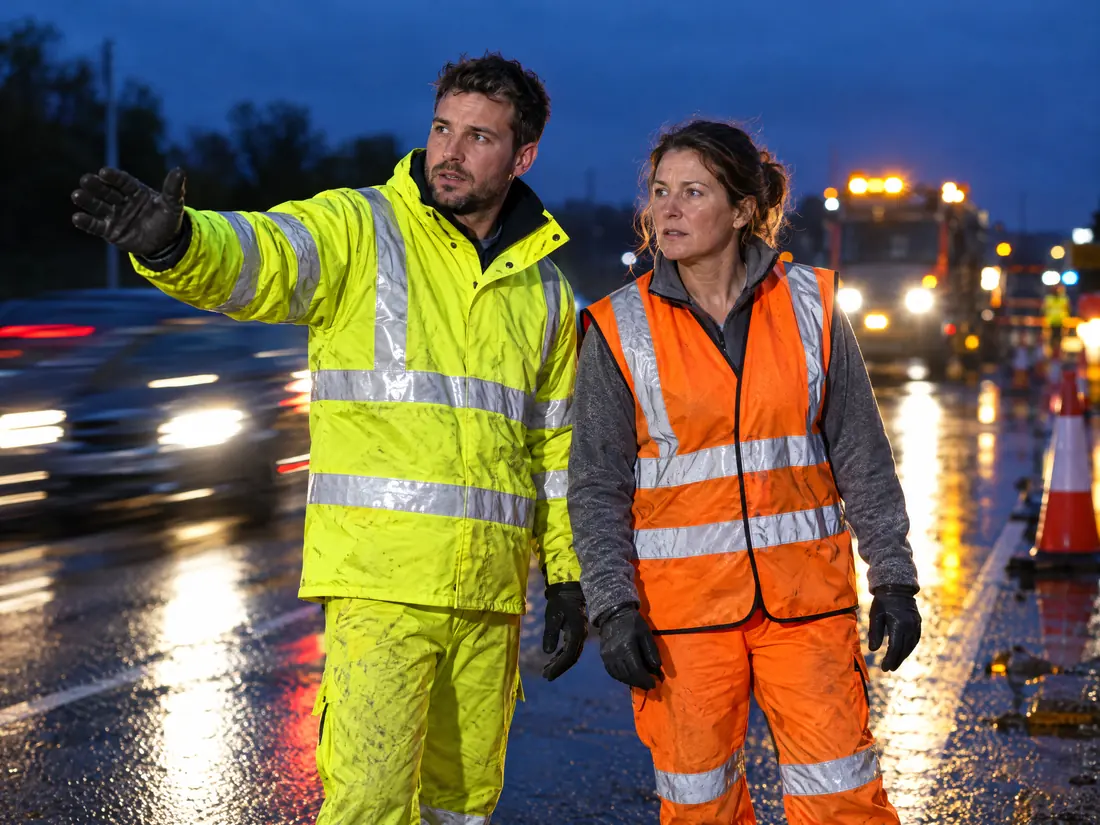
For roadside work, DGUV Information 212-016 (November 2025), published by DGUV, the umbrella body of Germany's statutory accident insurers, gives hard numbers. It accepts class 2 in two cases: where visibility is adequate, fewer than 600 vehicles an hour pass and average speed stays under 60 km/h, or for daylight work entirely inside a fully protected, long-duration road works site. Class 2 is also the minimum for emergencies such as a vehicle breakdown, and class 1 is not enough on its own on a public road.
Class 3 is required where any one of the following applies. Grounds and municipal crews carrying brush cutters or leaf blowers usually fall under the sixth point:
- Poor visibility
- Average traffic speed above 60 km/h
- More than 600 vehicles an hour
- Crossing multi-lane carriageways on foot
- Working in darkness
- Parts of the garment often covered by tools or loads
- Frequent movement between protected and unprotected areas
- Short-duration work sites without separate protection
- Work carried out while site protection is being set up, or without it
Washing, storage and when to replace
The wash count on the label is a ceiling, not a lifespan. Too much washing tires the fluorescent dye and the tape; too little does the same damage with a layer of grime. The right frequency follows how fast the garment gets dirty.
A few rules cover most of it: stay within the temperature and drying symbols on the label, avoid detergents with bleaching agents, which can affect the fluorescent colour, and wash hi-vis separately from other coloured clothes.
Storage matters as much. Fluorescent dye fades noticeably under UV, so a vest left on a van dashboard or seat ages far faster than one in a locker. A dry, ventilated place out of direct sunlight is all it needs.
Checks run on two levels. The wearer looks the garment over before each use, and where a laundry service is used, it inspects after every wash. Tape that looks intact in daylight says little about how well it reflects, and fluorescence can only be measured in an equipped laboratory. In practice the rule is simple: when dirt, ageing or fading leaves visibility inadequate, the garment is replaced.
Garments contaminated with chemicals or biological agents are not washed at home. Flame-retardant hi-vis also needs professional cleaning. Those garments must meet both EN ISO 20471 and EN ISO 11612, and the synthetic fibre that carries the fluorescent colour is what makes combining the two difficult.
How EN 17353 differs: medium risk and non-work use
EN 17353:2020 covers enhanced-visibility equipment for medium-risk situations. It replaced EN 1150:1999 and EN 13356:2001, two older standards aimed at the general public rather than at workers. Cycling vests, running armbands and reflectors hung from a bag are its typical products, and some work around slow-moving vehicles can also fall under medium risk.
Instead of classes it uses types. Type A relies on fluorescent material only, for daylight. Type B relies on retroreflective material only, for darkness, at three levels: B1 for free-hanging items, B2 for bands on the arms or legs, B3 for designs that include the torso. Type AB combines both, with AB2 focused on the limbs and AB3 on torso and limbs.
At work the line is clear. EN ISO 20471 is written for high risk and EN 17353 for medium risk. DGUV guidance allows EN 17353 garments and accessories in traffic-exposed work only in addition to EN ISO 20471 clothing.
The next edition of the standard puts that line in its title. The revision draft, ISO/DIS 20471, is titled for ‘high risk situations’, and its ballot closed in June 2026. Until the new edition is published, 2013+A1:2016 remains the reference on labels; whether any thresholds change will only be clear on publication.
Standards and regulations referenced
- EN ISO 20471:2013+A1:2016
- ISO/DIS 20471:2026 (taslak / draft)
- EN 471:2003+A1:2007
- EN 17353:2020
- EN 1150:1999
- EN 13356:2001
- EN ISO 13688
- ISO 3758
- EN ISO 11612
- ANSI/ISEA 107
- Regulation (EU) 2016/425
- Kişisel Koruyucu Donanım Yönetmeliği (2016/425/AB), RG 01.05.2019, 30761
- Kişisel Koruyucu Donanımların İşyerlerinde Kullanılması Hakkında Yönetmelik, RG 02.07.2013, 28695
- 6331 sayılı İş Sağlığı ve Güvenliği Kanunu
- DGUV Information 212-016 Warnkleidung (11/2025)
- HSA Information Sheet: High visibility clothing for use around moving vehicles (10/2022)
- RSA 21 (DE)
- RIS-3279-TOM (UK)
- MUTCD (US)