What the law says: Regulation 852/2004, Turkish food hygiene law and audit standards
The core EU rule is in Annex II, Chapter VIII of Regulation (EC) No 852/2004 on the hygiene of foodstuffs: everyone working in a food-handling area must keep “a high degree of personal cleanliness” and wear “suitable, clean and, where necessary, protective clothing”. Turkey's Food Hygiene Regulation (Gıda Hijyeni Yönetmeliği), published in the Official Gazette on 17 December 2011 (issue 28145), carries the same duty in Article 17, and its Article 3 states that it was drafted in parallel with 852/2004.
The legal wording on clothing is short because the detail belongs to the business. Neither text defines “suitable”; that is the job of the site's procedures based on HACCP principles (Article 5 of 852/2004). A biscuit packing line and a sliced cooked-meat line will not end up in the same clothing. The law sets no figure for colour, fabric, type of hair cover or wash temperature. The site sets those figures and must be able to justify them at audit.
Two related duties sit alongside. Annex II, Chapter I asks for adequate changing facilities for personnel where necessary, and the Turkish text adds showers (Article 10(9)). On the floor, the most visible result is outdoor clothes and workwear kept in separate lockers. Chapter XII requires food handlers to be supervised and instructed or trained in food hygiene matters relevant to their work; Article 21 of the Turkish regulation says the same. A clothing rule that is written down but never trained or checked on the floor stays on paper. In Turkey, plants handling meat, dairy and fish also fall under the specific hygiene regulation for food of animal origin (Official Gazette 27.12.2011, issue 28155).
Exporters meet further texts. In the United States, 21 CFR 117.10 lists outer garments suitable to the operation, removal of unsecured jewellery, gloves kept intact and clean, and hair nets, caps or beard covers where appropriate. Private audit standards, namely BRCGS Food Safety and the ISO 22002 prerequisite programmes that FSSC 22000 builds on, turn these general duties into checklist items. ISO 22002-1:2025 replaced ISO/TS 22002-1:2009 in July 2025 and is read together with ISO 22002-100, so certified sites should agree their transition timetable with their certification body.
| Source | What it says | What it means for clothing |
|---|---|---|
| Regulation (EC) No 852/2004, Annex II, Chapter VIII | Everyone in a food-handling area keeps a high degree of personal cleanliness and wears suitable, clean and, where necessary, protective clothing | The site's hazard analysis defines “suitable” |
| Food Hygiene Regulation (Turkey), Article 17 (Official Gazette 17.12.2011, No 28145) | The Turkish equivalent of the same provision | Binding on every food business in Turkey |
| Food Hygiene Regulation (Turkey), Article 10(9) | Changing facilities and showers where necessary | Outdoor clothes and workwear in separate lockers |
| Food Hygiene Regulation (Turkey), Article 21 | Staff are instructed or trained in hygiene | Dressing order and change rules taught in training |
| 21 CFR 117.10 (USA) | Suitable outer garments, jewellery removed, intact and clean gloves, hair and beard covers where appropriate | Checked at audit for sites exporting to the US |
| Codex, General Principles of Food Hygiene (CXC 1-1969) | Suitable protective clothing, head covering and footwear; visitors follow the same rules | Visitor and contractor kit |
Garment design: pockets, fasteners, collars and cuffs
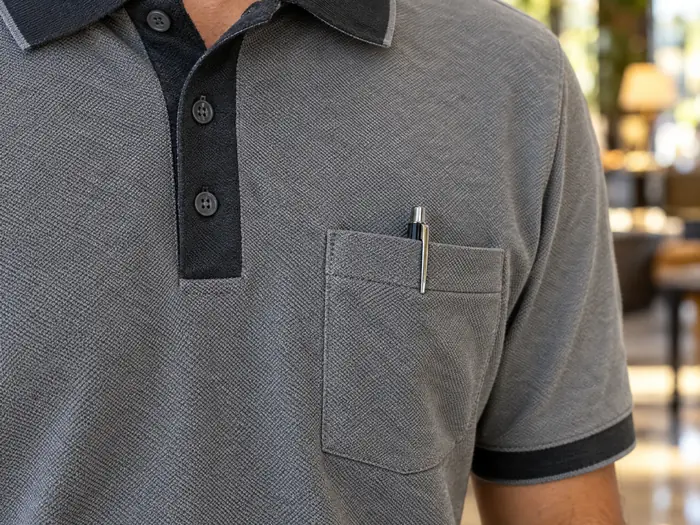
Every design decision on a food garment answers one question: if this part comes off, or whatever is inside it falls out, where does it land? So external pockets above the waist come off the pattern. A pen, phone or lighter in a breast pocket drops straight onto the product the moment the wearer leans over the belt. If a pocket is needed, it goes inside the garment or below the waist, ideally under a flap.
Sewn-on buttons go next. A plastic button that comes off is small, hard and often white, so it is easy to miss by eye and invisible to a metal detector. Stainless press studs, studs hidden under a placket, or zips take their place. Metal studs bring a bonus: if a cap does break off on the line, the metal detector has a chance of catching it. Name badges follow the same logic. On the production floor an embroidered or printed name is safer than a pin badge.
Collars and cuffs are where hair and sleeves come closest to the product. A closed stand collar or round neck stops the wearer's own clothes from showing and covers the nape where loose hair collects. On long sleeves a knitted or elasticated cuff hugs the wrist, so the sleeve does not trail into product and arm hair stays inside. Some sites prefer short sleeves for comfort. Arm hair then becomes a hazard in its own right, often handled with disposable sleeve covers.
White or pale shades are chosen because they show soiling at once, so a dirty garment gets changed rather than worn for another hour. The rest is workmanship. Loose thread ends, hanging loops, decorative tape and stuck-on badges can all detach. On aprons, long strings can catch in machinery; press studs or short, firmly stitched ties are safer.
Colour coding by zone
Colour coding turns a garment into the marker of a hygiene boundary. A coat that walks from the raw meat room into the cooked product room carries whatever is on it; a different colour makes that crossing visible from the far end of the hall. No regulation prescribes a scheme. Each site builds its own around the points where product is exposed and where recontamination after cooking would do the most harm.
Two mistakes come up again and again. The first is too many colours: seven zones in seven colours will not survive a new starter's second week. The second is putting the colour only on the hairnet. Hairnets are swapped constantly, so they are the first signal to break down. Colour on the body of the coat, or on the collar and cuffs where it is read at a glance, lasts longer. Sites that segregate allergens, for instance a nut line from a nut-free line, can use the same logic for that boundary.
The scheme also has to survive the laundry. A pale blue trim that fades to white within six months marks the same zone as a brand-new white coat, and the system quietly falls apart. Coloured parts should be cut from fabric dyed to withstand hot washing, with shade consistency checked against a sample on the first order. The table below is an example, not a standard.
| Zone | Product status | Example clothing | On entry |
|---|---|---|---|
| Goods-in, low-risk production | Raw or packaged | White coat, green collar and hairnet | Hand wash, boot sanitising |
| High-hygiene area | Cooked or ready-to-eat, exposed | All-white suit, red trim | Full change of clothing and boots, hand wash and sanitise |
| Packing | Inside primary packaging | White coat, blue trim | Hand wash, coat and hairnet check |
| Maintenance and engineering | Line stopped, or intervention while running | Blue coverall; that zone's coat on entry | Tool count, zone coat and hairnet |
| Hygiene team | Line wash-down, chemical use | Yellow coat, chemical-resistant gloves | Chemical apron and gloves stay in the zone |
| Visitors and contractors | Temporary access | Disposable coat, different-coloured hairnet | Jewellery left behind, health declaration |
Hairnets, beard nets and the visitor kit
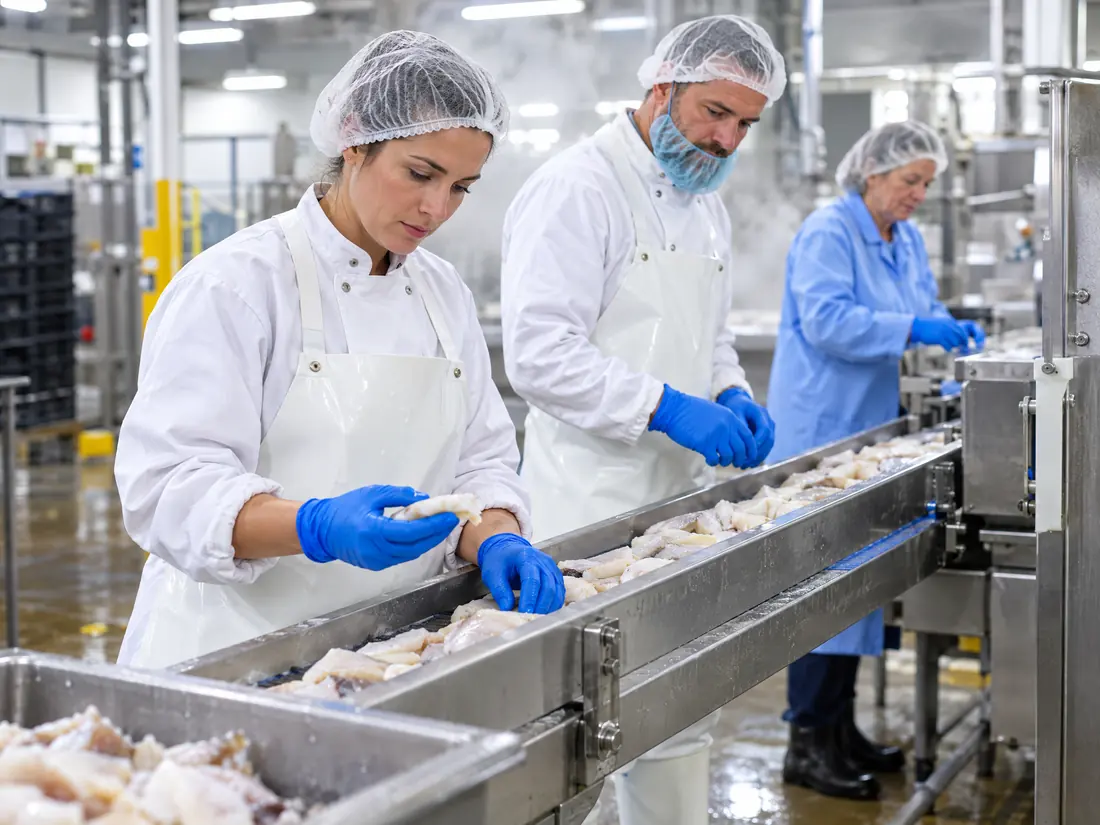
Hair is a foreign body consumers spot instantly, and the defence against it is the smallest item in the kit. A hairnet should cover all the hair, the ears and the nape. A fringe escaping at the front or a ponytail hanging below the back edge is the first thing an auditor looks for. A peaked cap looks tidy but does not contain hair; where product is exposed, it goes on top of a hairnet, not instead of one.
A beard net, also sold as a beard snood, is a light cover that wraps beard and moustache down under the chin. Where product is exposed, a hairnet and beard net together are needed by anyone with facial hair, and it is safer to count a few days' stubble too. US food manufacturing rules (21 CFR 117.10) name beard covers alongside hair nets, headbands and caps. Disposable nets are replaced at the start of each shift and after breaks. Reusable ones must come back from the laundry with their shape and elastic intact.
Dressing order is a rule in itself: hairnet first, coat second. Put the coat on first and any hair shed while fitting the net lands on the shoulders and rides into production. Undressing runs in reverse. A mirror in the changing room and a simple poster showing the sequence keep the training fresh every morning.
Visitors, contractors and service engineers are not exempt. Codex's General Principles of Food Hygiene extend the personal hygiene rules to visitors: where appropriate, they wear protective clothing and follow the same provisions as staff. A kit waiting at the door makes that painless:
- A disposable or laundered coat in a distinct colour, so visitors stand out from a distance
- Hairnet, plus a beard net where needed
- Overshoes or site-issued boots, because outdoor shoes stay out of production
- A box for jewellery, watches and pocket items, and a short health declaration form
Fabric and wash temperature
Food manufacturing workwear is washed hot and often, and fabric is chosen with that in mind. Polyester-cotton blends shrink little, dry fast and keep their shape through hot cycles. High-cotton fabrics breathe better but shrink and crease more. Cotton-rich for hot lines such as ovens and fryers, polyester-rich for cold, wet lines is a sensible starting point; shift length and room temperature make the final call.
Food law gives no wash temperature. A concrete figure comes from healthcare. According to NHS England's 2020 guidance on uniforms and workwear, ten minutes at 60 °C removes almost all micro-organisms, while a 30 °C wash with detergent already gets rid of most Gram-positive bacteria, MRSA included. Its advice to buyers follows from that: think twice about garments whose care label allows only a low-temperature wash or dry cleaning. For a food site the takeaway is plain: the care label should allow at least 60 °C, and coloured parts should not fade at that temperature.
Where garments are washed is the next question. The same NHS guidance sees little gap between home and industrial washing when it comes to removing micro-organisms; in a food plant the issue is control, not the machine. A coat washed at home shares the drum with family laundry, travels on the bus and comes back as clean as one person decided it should be. High-risk production therefore relies on an on-site laundry or a contracted industrial launderer, with records that show the process works. When comparing fabrics for industrial laundering, the test procedures in ISO 15797 are a useful reference: dimensional change, colour, creasing and seam puckering are assessed with them.
Sets per person come down to simple arithmetic. If garments change every shift and the laundry loop takes two days, at least three sets per person are in circulation, plus one spare and one for repairs. A plan built on fewer than five sets usually runs short the first time a coat tears or a laundry delivery is late. If you send Formasan headcount, change frequency, laundry method and zone colours in one request, the set count can be settled in the first round.
Let's choose the right product for your team
Tell us the site conditions, quantity and the standard you need; we come back with fabric, model and sample options.
Food industry boots and slip-resistant soles
Feet in food production face two separate problems: slipping on wet floors and carrying dirt in from outside. The UK Health and Safety Executive (HSE) counts slips and trips among the main causes of accidents in food and drink manufacturing. Most of them happen on floors made wet by water or by the product itself.
Footwear alone will not stop slipping, but it carries much of the load. According to HSE, sole materials differ widely in grip, and on wet floors soft, well-patterned soles such as microcellular urethane tend to slip least. HSE also puts numbers on the floor itself: at least 20 microns of surface roughness (Rtm) where water is the contaminant, 45 microns for milk and 70 for olive oil. In a room where milk gets spilled, check the floor before blaming the boots.
Two standards turn up on labels. Safety footwear with a toe cap is certified to EN ISO 20345; occupational footwear, which needs no toe cap, to EN ISO 20347. Both are current in their 2022 editions (with the A1 amendment of 2024), and slip resistance is part of both. Since 2022 a slip test on ceramic tile wetted with a detergent solution has been among the basic requirements, while passing an extra test on glycerine-coated ceramic tile earns the SR marking. On lines where oil, syrup or animal fat reaches the floor, look for SR. If forklifts or pallet trucks work nearby, the risk assessment will point to a toe cap.
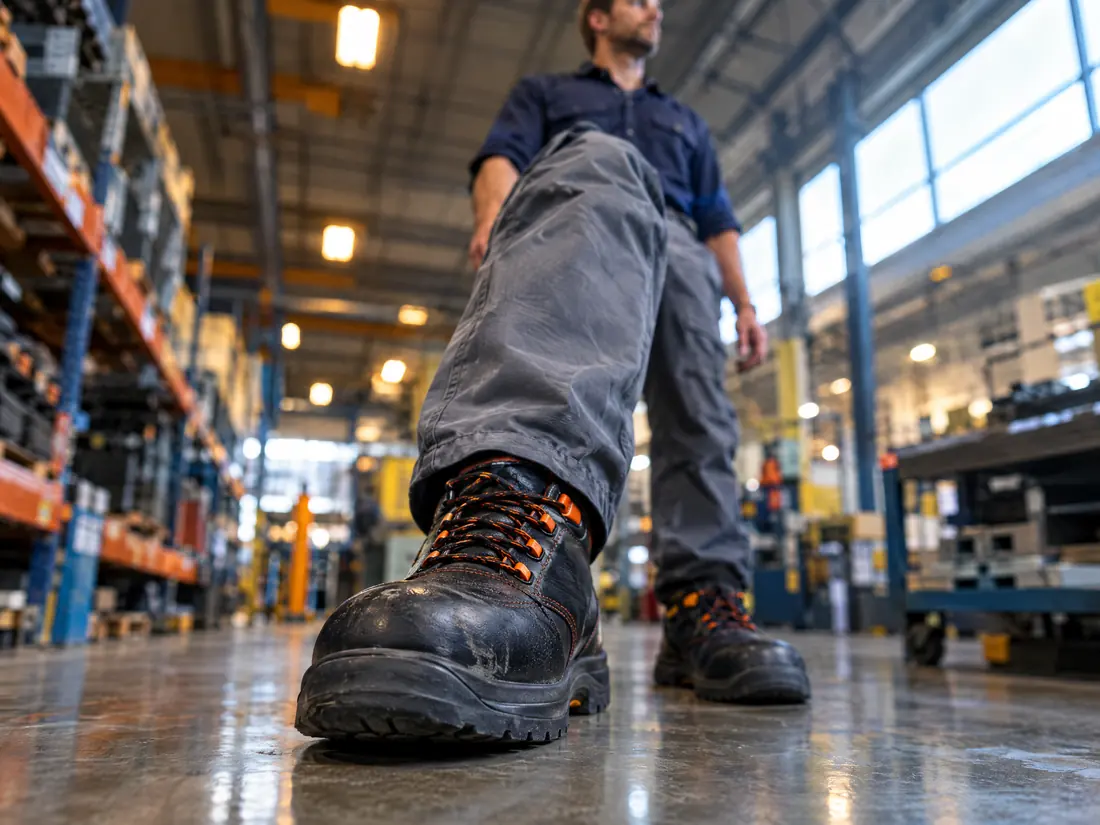
White boots are not mandatory, but they are popular because dirt and blood show immediately. Look for a one-piece moulded upper with no seams, a smooth surface that does not trap residue and an open, self-cleaning tread. PVC is economical and waterproof; in meat and dairy plants, where animal fat is everywhere, nitrile or polyurethane compounds are preferred because they stand up better to it. Trousers go over the boot, never tucked in, or wash-down water and splashes run straight inside. A boot wash and sanitising station at the entrance leaves outside dirt at the zone boundary.
Formasan manufactures the workwear itself and sources food industry boots and disposable gloves. Putting all of it on one quote makes it easy to check boot and hairnet colours against the zone scheme from the start.
Blue gloves and detectable materials
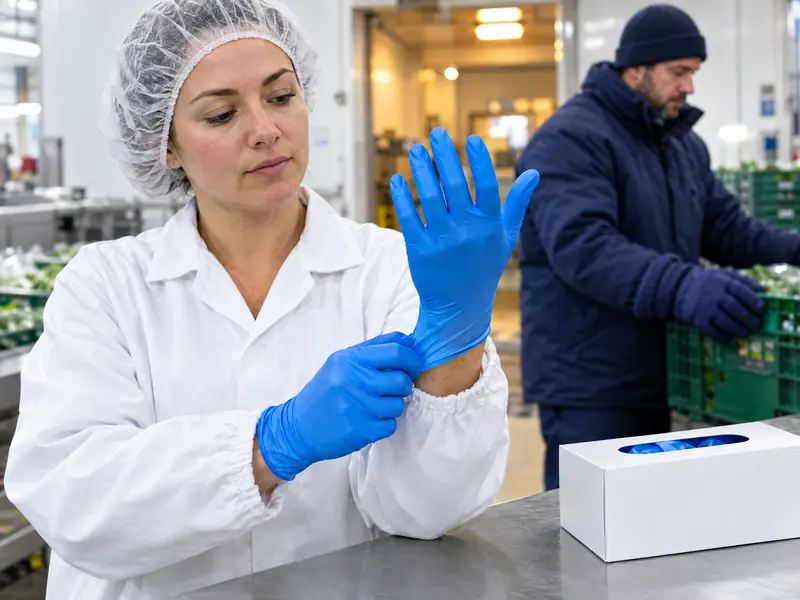
The colour of a disposable glove is not a legal requirement; it is a detection method. Very few foods are naturally blue, so a torn fragment stands out against white dough, red meat or yellow cheese and is more likely to be caught by an optical sorter. Hence the blue gloves, blue plasters and blue disposable aprons seen on so many food lines.
Where the eye is not enough, the metal detector takes over. Detectable products have metal particles compounded into the plastic or rubber, so a glove fragment, plaster or pen cap can show up on the line's metal detector or X-ray system. How small a piece your own detector actually finds is something to establish with a trial on your line, not something to take from a datasheet.
Material choice comes down to two questions. The first is food contact. In the EU, Regulation (EC) No 1935/2004, and in Turkey the Turkish Food Codex regulation on food contact materials (Official Gazette 05.04.2018, issue 30382, Article 13), require food contact materials placed on the market to carry the words “for food contact”, a use-specific description or the glass-and-fork symbol. The second is the wearer's skin. HSE ranks occupational dermatitis among the most common health problems in food processing, with rubber and latex gloves on its list of triggers. A worker sensitive to latex may need another material or a cotton-lined glove.
Protecting the wearer is a separate question. EN ISO 374-5 sets out how gloves protect the user against micro-organisms; that marking says nothing about food suitability, and a food-safe glove may not protect against cleaning chemicals either. Gloves do not replace hand washing. They are changed when moving from raw to cooked product, or from the bin back to the belt. In boning and cutting rooms a cut-resistant glove goes underneath and a disposable glove on top; the cut level is read from the EN 388 code.
Layering in chilled and frozen areas
Cold-chain work keeps every hygiene rule and adds a heat problem. Badly planned layering fails in one of two ways. Either the thermal jacket replaces the hygiene coat and the zone colour disappears, or a cold worker slips a fleece from home under the coat. Both are solved by treating the thermal layer as part of the clothing system rather than an afterthought.
Layers build from the skin outwards. Next to the skin goes a thin base layer that wicks sweat away; cotton stays wet here and chills. Insulation sits in the middle, and the outer layer is a washable jacket in the zone colour, or a coat worn over the thermal jacket. A thin thermal hood under the hairnet, and a thermal liner under a food-safe disposable glove, make a workable set. The thermal layer needs regular washing too; a padded jacket whose filling clumps in the wash is the wrong product for that zone.
Which standard applies depends on the room temperature. Individual garments for cool conditions above −5 °C are tested to EN 14058; suits and coveralls for −5 °C and below fall under EN 342. For gloves, EN 511 measures protection with convective cold and contact cold tests. HSE's guidance for chilled and frozen food plants gives a useful rule of thumb. Around 0 °C in a chiller, the right clothing and ordinary breaks usually do the job. In blast freezers that reach −30 °C, clothing and PPE cannot do it alone, and workers need breaks in a warming room or at normal room temperature.
| Standard | Scope | Typical place in a food plant |
|---|---|---|
| EN 14058:2017+A1:2023 | Cool-environment garments, above −5 °C | Chilled processing hall, cold room |
| EN 342:2017 | Cold-environment suits and coveralls, −5 °C and below | Frozen product store |
| EN 511:2006 | Protective gloves against cold; convective and contact cold tests | Crate and pallet handling in cold stores |
Common clothing findings in HACCP, ISO 22000 and BRCGS audits
An auditor looks at clothing as a system, not as a rack of garments: is the rule written down, has it been trained, is it followed on the floor, and is there a record? Some findings start at the purchasing stage. If people wear torn coats because there are not enough sets, if a faded trim no longer marks the zone, or if fabric that cannot take a hot wash ends up on a cool cycle, the problem was written into the specification.
A one-page clothing specification, written before anything is bought, prevents most of this: the list of zones and their colours, sets per person and change frequency, laundry method and temperature. When an auditor asks why a garment was chosen, the answer is on the same page. The specification sits under the site's hazard analysis and the regulations that apply; the examples on this page are a starting point for that analysis, not a substitute.
Whether the framework is a HACCP plan, an ISO 22000:2018 management system or the BRCGS Food Safety standard makes little difference. Most clothing findings come from the routine around the garments rather than the garments themselves. The ones auditors see most often:
- Wearing production coats to the toilets, the canteen or outside; not changing when moving between zones.
- Hair escaping from the hairnet, ears and nape uncovered, no beard net at all.
- Pens, phones or cigarettes in pockets above the waist.
- Jewellery, watches and piercings, with no written rule on what counts as an exception.
- Torn coats, open seams or missing studs still in use.
- Clean and dirty garments sharing a locker or trolley; outdoor clothes hanging next to workwear.
- Home laundering, or no record of wash temperature and effectiveness.
- Visitors and contractors in incomplete kits; one pair of disposable gloves carried across different tasks.
Standards and regulations referenced
- Regulation (EC) No 852/2004
- Gıda Hijyeni Yönetmeliği (RG 17.12.2011, sayı 28145)
- Hayvansal Gıdalar İçin Özel Hijyen Kuralları Yönetmeliği (RG 27.12.2011, sayı 28155)
- Regulation (EC) No 1935/2004
- Türk Gıda Kodeksi Gıda ile Temas Eden Madde ve Malzemelere Dair Yönetmelik (RG 05.04.2018, sayı 30382)
- 21 CFR 117.10
- Codex Alimentarius CXC 1-1969, General Principles of Food Hygiene
- ISO 22000:2018
- ISO 22002-1:2025
- ISO 22002-100:2025
- ISO/TS 22002-1:2009
- ISO 15797:2017
- EN ISO 20345:2022
- EN ISO 20347:2022
- EN ISO 374-5:2016
- EN 14058:2017+A1:2023
- EN 342:2017
- EN 511:2006
- HSE: Safety hazards in food and drink manufacturing
- HSE: Chilled and frozen food products – workroom temperatures
- NHS England: Uniforms and workwear – guidance for NHS employers (2020)