From enquiry to delivery in seven steps
A custom order starts with a conversation, not an order form. In the first exchange the manufacturer wants to know who will wear what, in which job, and how the garments will be washed; the time and cost of every later step follow from those answers. A typical order runs through seven steps:
- Enquiry: product list, rough quantities, where the clothing will be worn and the date you need it.
- Needs and sizing analysis: hazards, laundering, departments and the size spread of your staff.
- Fabric and design: blend, weight, colour, pattern, pockets and reinforcement; the logo position and method are chosen here too.
- Sample: made up in one or more sizes, worn on site, pattern corrected if needed.
- Approval: fabric, colour, logo colour and position and label text are signed off in writing. The approved sample is kept as the reference for the whole run.
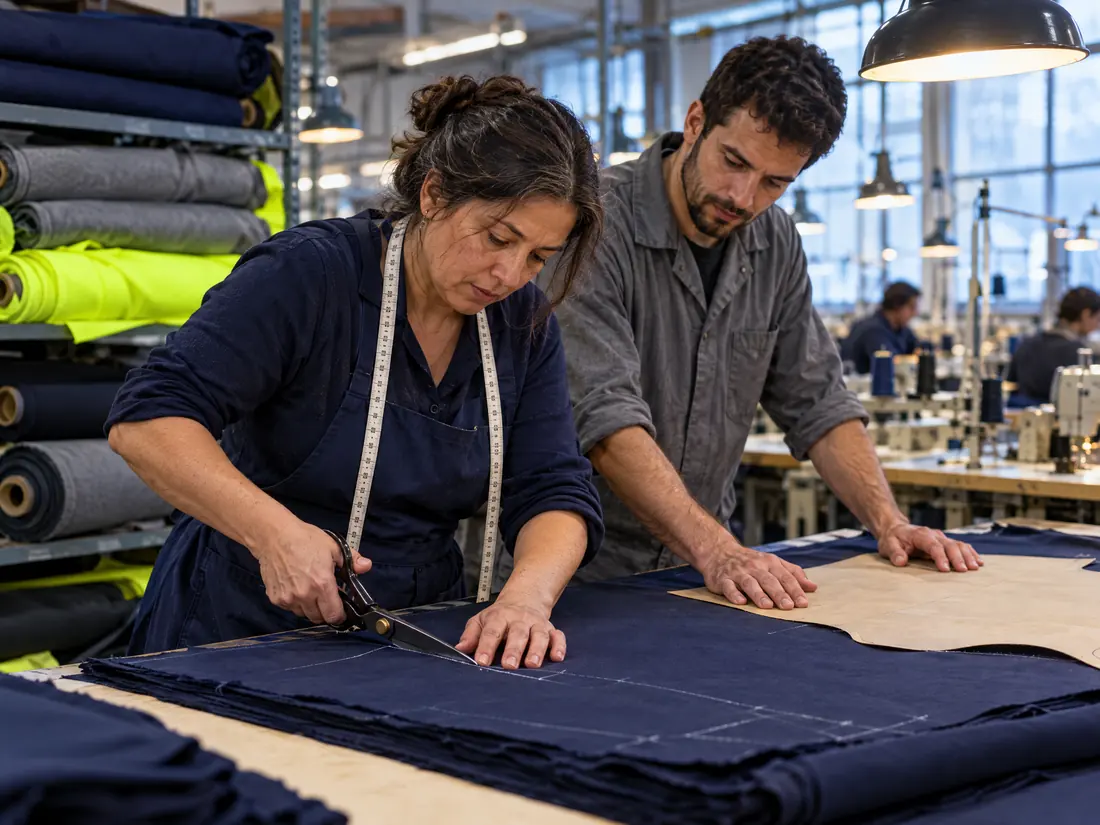
- Production: cutting, logo application, sewing, pressing and final inspection.
- Delivery: packing by person or department, shipment and delivery documents.
What sets the lead time?
There is no single lead time, but the items that stretch it are predictable. Fabric is the biggest variable. Working from cloth the manufacturer already holds is one schedule; waiting for a batch dyed to your corporate colour is a noticeably longer one. Sample rounds come next: a garment approved at the first sample and one whose pattern is corrected three times do not finish on the same date.
Branding adds its own steps. For embroidery the logo is converted into a stitch file once and checked with a test sew-out; for screen printing a separate screen is prepared for each colour. Both are one-off jobs, and repeat orders reuse the same artwork files. Packing per wearer, name embroidery or numbered issue labels lengthen the last stage, because every pack has to be matched individually.
Final inspection is usually done by sampling rather than by opening every piece. The sampling plan and the acceptance quality limit (AQL) can be written into the order with reference to ISO 2859-1. Its current edition dates from 2026 and replaced the 1999 edition. Both sides then know before delivery what counts as a defect.
Needs analysis: workwear or PPE, and how will it be washed?
The first distinction decides the paperwork. Uniforms and ordinary work clothing that give no specific protection are not personal protective equipment. The European Commission's guidelines on the PPE Regulation (EU) 2016/425, fifth edition of October 2025, say so in as many words. A reception jacket, an engineer's vest without hi-vis or a logo polo shirt belong in this group. If you need high visibility, flame, welding or antistatic protection, the garment is PPE and comes with fabric and design tested to the relevant standard and a CE mark. Writing down which item belongs where at the start avoids an argument about certificates at delivery.
The second question is laundering, and it narrows the logo choice straight away. Will staff wash the garments at home, or will an industrial laundry handle them? Industrial washing puts more heat, chemistry and mechanical action into a garment than a domestic machine, and garments may then go through a tunnel finisher. ISO 15797:2017 sets out the industrial washing and finishing procedures used to test workwear: eight washing procedures for cotton and polyester-cotton garments. What to measure afterwards, such as shrinkage or colour change, is set by separate test standards.
Garments that go to a laundry also have their own label mark. The familiar care symbols of ISO 3758:2023 cover home treatment and professional dry and wet cleaning, and they explicitly leave industrial laundering out. The marks that qualify a garment for laundry processing are defined in ISO 30023:2021 and are tied to the ISO 15797 procedures. The logo goes through the same cycle, so this is where the list of workable methods gets shorter.
Count the variants at this stage as well: departments, women's and men's patterns, summer and winter sets. Each one is a separate pattern and a separate size run.
Logo application methods compared
Five methods are common on workwear, and none of them suits every garment. Read the durability column as “under industrial laundering”: a decoration that survives a home machine can behave quite differently in a laundry cycle.
Embroidery stitches thread straight into the fabric. The logo is first turned into a stitch file; that digitising is done once and the same file serves every repeat order. Machine embroidery thread is usually polyester or rayon. Rayon loses durability when wet, so for garments washed hot and often polyester is the safer pick for colourfastness and strength. Scale is the weak spot. Shrink a logo to 8 or 9 cm across the chest and a fine tagline underneath can vanish into the thread.
In screen printing, ink is pushed through a separate screen for each colour, so a three-colour logo means three screens and three passes. Because set-up cost is spread over the quantity, the unit price is high on 50 pieces and low on 1,000. Plastisol is the most common garment ink. It covers well on dark fabric and cures with heat, at around 150 °C for many inks. An under-cured print can crack or lift in the first washes, which is why asking the manufacturer for a wash test result is a fair request.
DTF (direct-to-film) is a transfer method. The design is printed onto PET film, backed with white ink and a thermoplastic polyurethane hot-melt powder, then heat-pressed onto the garment at 160 to 170 °C for 10 to 15 seconds. No pre-treatment is needed, and it works on cotton, polyester and dark grounds. For a detailed multi-colour logo on a run of 30 jackets it is usually the practical route. The trade-off is a slightly plasticky feel and an adhesive whose life depends on press settings, so wash a test piece first if the garment is going to an industrial laundry.
Sublimation turns dye into a gas under heat so that it enters polyester fibres. Nothing sits on the surface, you cannot feel it and it does not crack. It does not take on cotton. There is no white ink in the process, so it needs a white or very light ground; you cannot sublimate a white logo onto a navy work T-shirt. Its place in workwear is narrow as a result: light polyester shirts and team-style tops.
A woven badge or embroidered patch is made separately, then sewn on, heat-sealed or attached with hook-and-loop. Sewn on, it copes best with a laundry. Heat-sealed badges can start lifting at the edges with frequent hot washing. Hook-and-loop backing makes sense when the same jacket moves between crews or projects.
| Method | Durability in industrial laundering | Suitable fabrics | Detail | Quantity logic |
|---|---|---|---|---|
| Embroidery | High, if thread and stitch density suit the fabric | Woven fabrics, heavy knits, fleece, caps; risk of puckering on thin, stretchy fabric | Medium; hairlines and small lettering fill in | Design digitised once; cost driven by stitch count |
| Screen printing | High, if the ink suits the fabric and is cured correctly | Cotton, polyester and blends; ink chosen to match the fabric | Good; flat colours and crisp lines, gradients via halftones | One screen per colour; cheaper as volume grows |
| Transfer / DTF | Medium; depends on the adhesive layer and press settings | Cotton, polyester, blends; dark grounds included | High; many colours, fine lines, gradients | No screens; strong on low quantities and multi-colour logos |
| Sublimation | High; dye enters the fibre, no surface layer | Polyester or polyester-coated surfaces; white or light ground | Very high; photographic quality, edge to edge | Digital; fabric limits matter more than quantity |
| Woven badge / patch | High when sewn on | Almost any fabric; sewn, heat-sealed or hook-and-loop | Fine detail possible when woven; an embroidered patch has the same limits as embroidery | Made separately and attached later; hook-and-loop badges move between garments |
Embroidery or print: choosing by garment
The question usually arrives as “which is better quality?”. The useful version is “for which garment, and washed how?”, and the answer changes from garment to garment.
The logo itself narrows the choice. Look at three things: the thinnest line, the number of colours and whether there are gradients. A one-colour logo with bold lines can work with all five methods, fabric permitting. A seven-colour logo with shading has to be simplified for embroidery, gets dearer with every colour in screen printing and prints as it is with DTF or sublimation. That is why some companies keep two versions of their logo, a full one for print and a simplified one for thread.
File format sounds minor, yet it shortens the sample round. A vector file (vector PDF, SVG or EPS) plus the colour codes from your brand guidelines lets the logo come out right first time. Rebuilding a logo from a screenshot or an email signature costs time and alters line weights.
Colour consistency can be measured. Colourfastness of the logo to washing is tested to ISO 105-C06:2010 and to rubbing to ISO 105-X12:2016, and the result is graded on the five-step grey scale of ISO 105-A02. C06 covers domestic and commercial laundering. Industrial and hospital laundering can be harsher; if the garments go to a laundry, putting logo and fabric through an ISO 15797 procedure gives a more realistic result.
These garment and method pairings come up most often on real orders:
- Polo shirts and shirts: embroidery on the chest. It looks corporate and copes with frequent washing.
- T-shirts and sweatshirts with a large back print: screen printing at volume; DTF for short runs and many colours.
- Membrane jackets and softshells: needle holes can compromise waterproofing. Use a transfer or a badge; if embroidery is a must, keep it to areas that do not take rain and back it.
- Caps and beanies: embroidery; a flat print does not sit well on a curved, seamed front panel.
- Chef jackets and hygiene wear: embroidery, because they are washed at high temperatures.
- Visitor and subcontractor vests: screen print or transfer for large lettering on the back, hook-and-loop badges where crews change often.
Let's choose the right product for your team
Tell us the site conditions, quantity and the standard you need; we come back with fabric, model and sample options.
Logos on hi-vis and flame-resistant clothing: keeping the standard intact
On a garment that is PPE, a logo is not decoration; it changes the thing that was tested. Article 12 of Regulation (EU) 2016/425, and Article 13 of Turkey's PPE Regulation, which mirrors it (Official Gazette 01.05.2019, No. 30761), treat an importer or distributor who modifies PPE already on the market in a way that may affect compliance as its manufacturer. The Commission's guidelines go further: anyone who substantially modifies PPE with a view to placing it on the market becomes a manufacturer. A supplier who has logos printed on certified vests and then delivers them to a customer may have taken on the manufacturer's obligations without realising it.
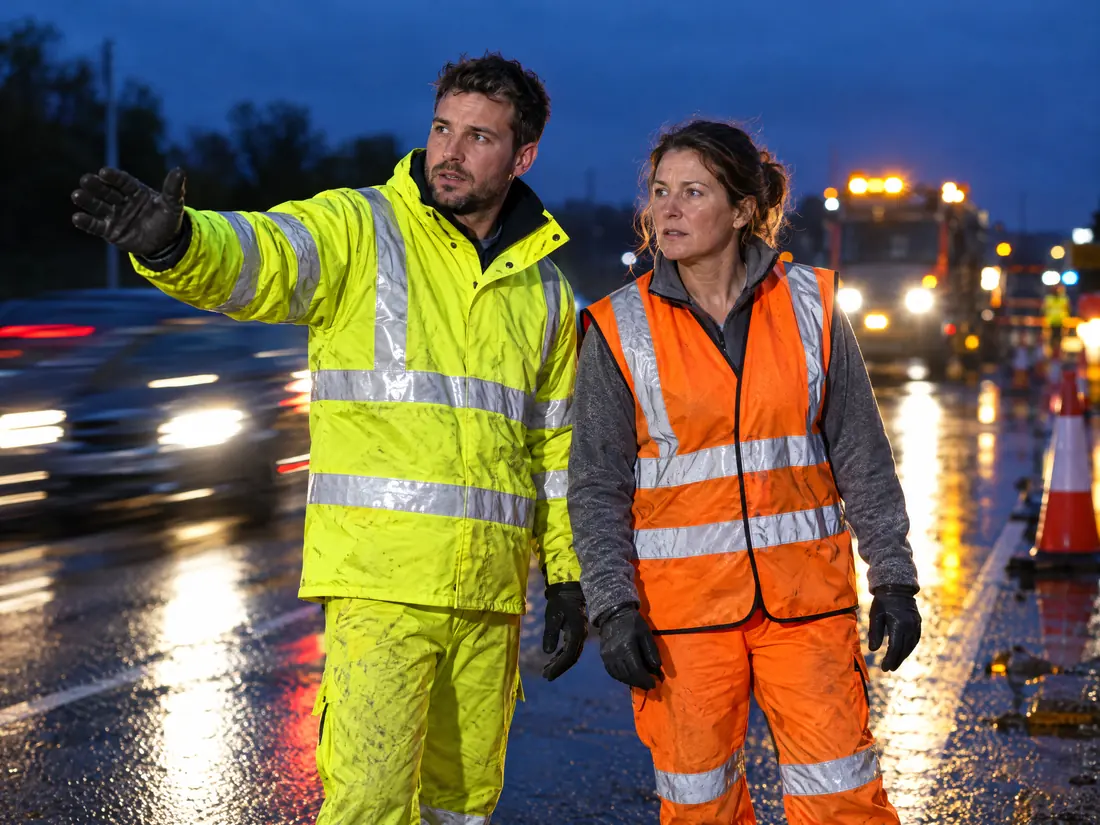
With high visibility the issue is area. The class depends on the minimum visible area of fluorescent background and retroreflective material. A logo printed on the fluorescent background reduces that area, and lettering over retroreflective tape cuts its reflection. That is why the warning clothing guide of DGUV, the umbrella body of Germany's statutory accident insurers (DGUV Information 212-016, November 2025), states that company logos, appliqués and lettering such as “safety officer” or “supervisor” may only be added after consulting the manufacturer and within the scope of the certificate.
In practice the fix is to move the logo off the fluorescent area: onto a dark shoulder or lower panel, a pocket flap or a separate badge. If a large company name is wanted across the back, it is planned at the pattern stage, either by enlarging the fluorescent area or by putting the lettering on a dark panel. Lettering added later to a certified model is only safe if the manufacturer has tested that application.
Flame-resistant hi-vis is stricter. The same DGUV guide says that labels, reflective strips and similar parts on the outside must not be made of flammable material, and that every part of flame-retardant warning clothing, properly applied prints included, has to stay flame-retardant for the whole life of the garment. For embroidery that means a flame-resistant thread such as aramid; ordinary polyester thread melts. If a transfer or badge is used, ask for evidence that the material has been assessed together with the garment to EN ISO 11612.
Antistatic clothing follows the same logic: a badge or label added to the outer surface can change how the garment handles static charge, so it is not added without asking the manufacturer. Whatever the hazard, a logo goes onto PPE in the way its manufacturer knows about and has tested.
Private label: woven labels, care labels and packaging
Private label means a product made by a manufacturer exclusively for one client, to that client's specification, and sold under the client's brand. With white label the manufacturer sets the specification and may supply the same product to several clients, each under its own name. For a company dressing its own staff, private label often comes down to a woven brand label in the collar. For a distributor reselling workwear under its own brand, the label shows who carries the legal responsibility.
In the EU, Regulation (EU) No 1007/2011 requires textile products to be labelled with their fibre composition whenever they are made available on the market. The label has to be durable, easily legible, visible and accessible, securely attached, and in the official language of the member state where the product reaches the consumer. A distributor who places a product on the market under its own name or trademark, or attaches the label itself, is treated as the manufacturer. Turkey's textile labelling regulation (Official Gazette 25.04.2015, No. 29337) sets the same core rules, requires the label in Turkish as well, and counts whoever puts their name or brand on the product as its producer. When goods are supplied to businesses within the supply chain or against a public authority order, accompanying commercial documents may replace or supplement the label.
PPE is where private label needs the most care. The same Article 12 and Article 13 also treat an importer or distributor who places PPE on the market under its own name or trademark as the manufacturer. The Commission's guidelines extend this to anyone who labels ready-made PPE and places it on the market under their own name. The PPE must carry the manufacturer's name, registered trade name or trademark and a postal address (Regulation Art. 8(6); Turkish Regulation Art. 9(6)). The guidelines also refer to manufacturers holding own-brand-label EU type-examination certificates. If you plan to sell a hi-vis vest under your own brand, whose name the certificate will be issued in is the first point to settle at the quote stage.
Packaging is part of private label too: individual polybags with a size and style sticker, carton labels and barcodes where needed. On corporate orders the detail that pays off most is packing per wearer. Each pack shows the employee's name and department, and a branch store can hand out kit without hunting for sizes. At Formasan, label content, packing format and logo colour are each approved separately before the production run.
| Label | What it carries | Basis |
|---|---|---|
| Woven brand label | The buyer's brand name or logo | Commercial choice; content approved before production |
| Fibre composition label | Fibre names and percentages; in Turkey also in Turkish | Turkish textile labelling regulation (OG 29337); in the EU, 1007/2011 |
| Care label | Washing, bleaching, drying, ironing and professional cleaning symbols | ISO 3758:2023 |
| Industrial laundering symbol | Suitability for ISO 15797 laundering | ISO 30023:2021 |
| PPE marking | CE mark, manufacturer's name and address, type or batch number, standard, size | EU 2016/425 Art. 8 and 17; Turkish PPE Regulation Art. 9 and 17; EN ISO 13688 |
How to plan the size breakdown
On a bulk order the most expensive mistake is the size split. Surplus XXLs and missing Ms are two sides of the same order. Build the list from measurement, not guesswork.
The most reliable method is a size set. One garment in every size comes to the workplace, staff try them on and choose, and the result goes onto a named list. Try-ons should happen in working kit, not over street clothes: if a fleece goes under the jacket and a tape measure and radio go in the trouser pockets, that is how the trial is done. On protective clothing, size is designated by body measurements under EN ISO 13688, so the chest girth and height on the label are a better guide than a letter size.
Make a few splits separately. Women may need their own pattern, because a scaled-down men's pattern does not sit right at the shoulders and hips. For trousers and coveralls, leg length matters as much as the waist; counting short and long fittings separately saves hemming on site. The same person can change size between summer and winter sets, since layers go under a winter jacket.
Then the reserve. A small stock for new starters, worn-out trousers and lost vests is easier than opening a one-piece order each time. A reserve cut from the same fabric batch also avoids the shade difference that can show on a top-up made months later. The first order's size split tells you which sizes to hold.
What to send when you ask for a quote
The more that is settled in the first message, the closer the first quote lands to the final one. Price is worked out from what you send but only becomes firm after sample approval. The quote should state the sample terms, minimum quantities, lead time and how final inspection will be done.
If you expect repeat orders, look for a commitment to keep the approved pattern, the fabric record and the logo file. That record is how you get the same garment in the same shade in year two.
Custom manufacturing and export enquiries to Formasan start from the checklist below. Buyers outside Turkey also settle the label language and the destination country's rules at this stage. What to include:
- Products and approximate quantities: per style, split by department.
- Working environment: the hazard and, where needed, the standard, for example EN ISO 20471 class 2 or EN ISO 11612.
- Laundering: home washing or an industrial laundry.
- Fabric and colour: preferred blend and weight, corporate colour code, or an existing garment as a reference.
- Logo: vector file, position and approximate size on each garment, preferred method.
- Size breakdown, or a request for a size set.
- Labels and packaging: your own brand label, care label language, packing per wearer.
- Delivery: number of addresses and target date; for export, the destination country.
Standards and regulations referenced
- Regulation (EU) 2016/425
- Kişisel Koruyucu Donanım Yönetmeliği (2016/425/AB), RG 01.05.2019, 30761
- PPE Regulation (EU) 2016/425 Guidelines, 5th edition (October 2025)
- Regulation (EU) No 1007/2011
- Tekstil Elyaf İsimleri ve Tekstil Ürünlerinin Elyaf Kompozisyonlarıyla İlgili Etiketleme ve İşaretleme Hakkındaki Yönetmelik, RG 25.04.2015, 29337
- EN ISO 13688:2013+A1:2021
- EN ISO 20471:2013+A1:2016
- EN ISO 11612
- ISO 15797:2017
- ISO 30023:2021
- ISO 3758:2023
- ISO 105-C06:2010
- ISO 105-X12:2016
- ISO 105-A02:1993
- ISO 2859-1:2026
- DGUV Information 212-016 Warnkleidung (11/2025)