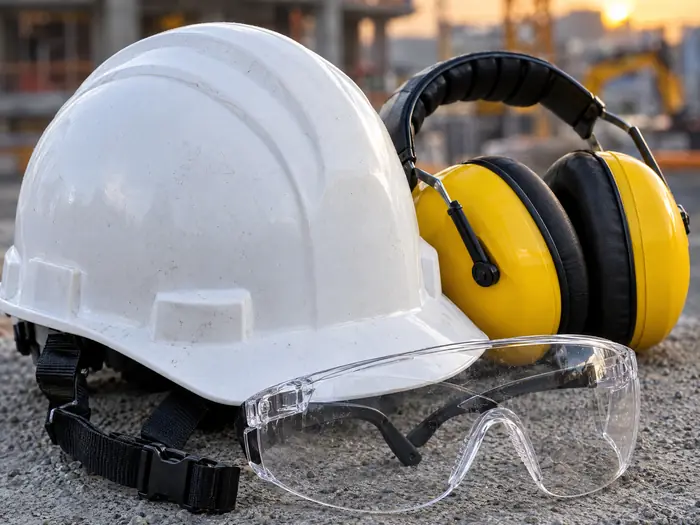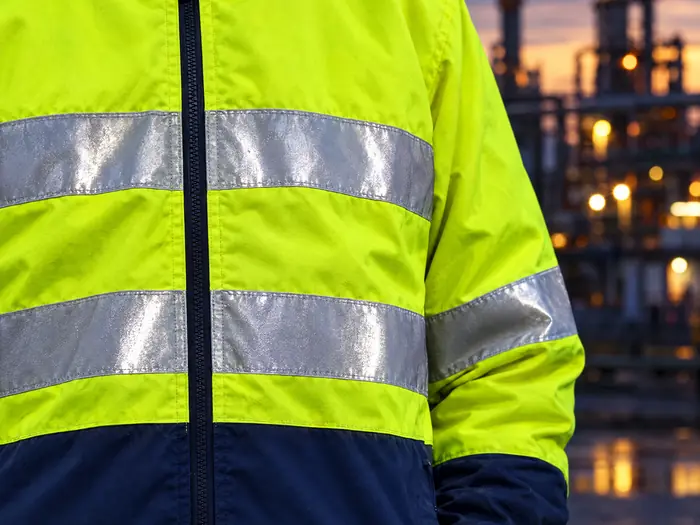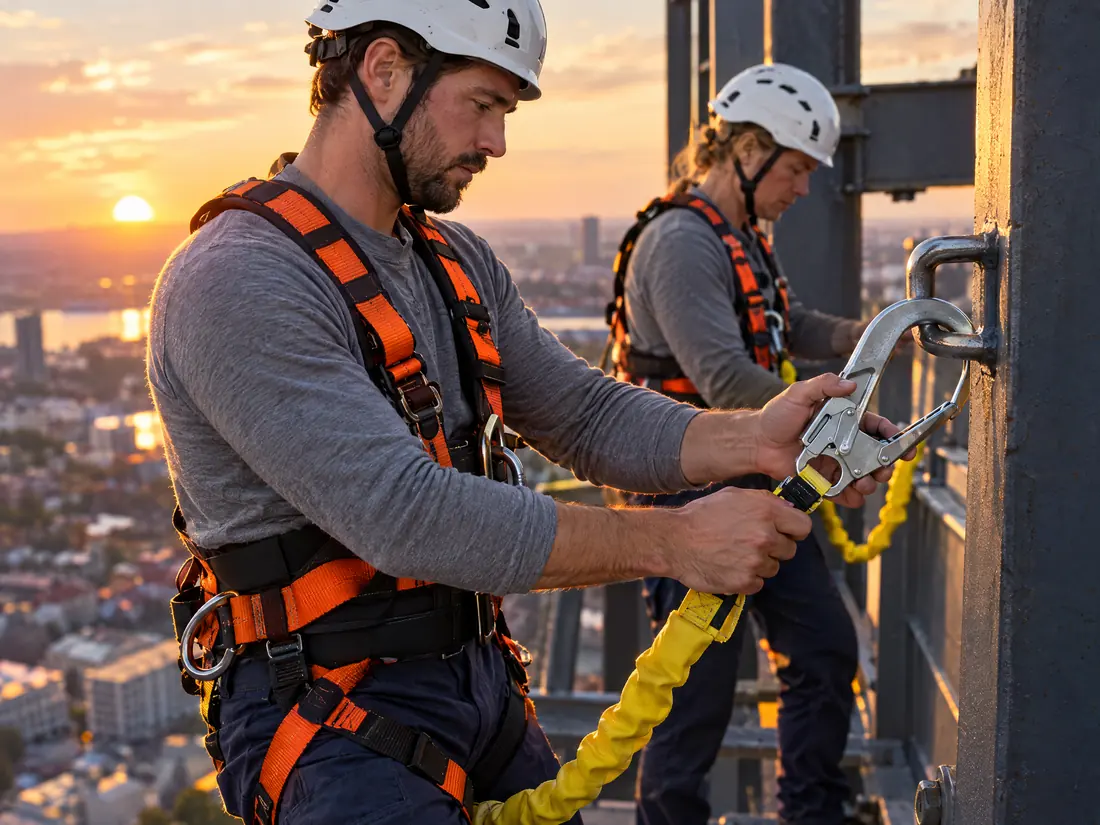

What counts as PPE, and what does not
Regulation (EU) 2016/425 defines PPE in three parts. At its core, PPE is equipment designed and made to be worn or held by a person as protection against one or more health or safety risks. Interchangeable components that the protective function depends on are PPE too, such as the filter on a half mask or the filter plate in a welding helmet. So are connection systems that link the equipment to an external device or an anchorage, provided they are not worn or held, not permanently fixed and need no fastening work before use. The Commission's example is an air line from a compressor to a respirator; on site, think of a webbing sling wrapped around a beam and removed without tools after the shift.
The operative word is 'designed'. Directive 89/656/EEC, the EU baseline for PPE use at work, leaves out ordinary workwear and uniforms that are not specifically designed to protect, and Turkey's workplace PPE regulation does the same. A cargo trouser with an embroidered logo is workwear. Give the same trouser fluorescent background material and retroreflective tape, design it to EN ISO 20471, put it through type-examination, and it becomes Category II PPE carrying a CE mark. Agreeing which of the two you are ordering avoids an argument about missing certificates at delivery.
PPE also sits at the bottom of the hierarchy of controls. The same directive says it is to be used when risks cannot be avoided or sufficiently limited by collective technical protection or by the way work is organised. For a noisy compressor, an enclosure, a silencer or shorter exposure comes first. Ear defenders deal with what is left.
PPE categories I, II and III under Regulation (EU) 2016/425
Annex I of the Regulation sorts PPE by the risk it protects against, not by product type. The manufacturer assigns the category according to the risks the product is designed for, and equipment that covers several risks goes into the category of the most serious one. Turkey's PPE Regulation uses the same three categories and ties each to the same conformity assessment modules.
Gloves show the logic well. A gardening glove against thorns and dirt is Category I. An assembly glove tested to EN 388 for cut and puncture is Category II. A glove against chemicals is Category III, and the European Commission's categorisation guide puts even single-use gloves for hairdressers there. Gloves that insulate against electric shock, or are made for environments of 100 °C and above, are Category III as well.
The Category III thresholds are not arbitrary. The Commission's PPE Guidelines tie the 100 °C limit to a heat flux that causes a second-degree burn on skin in under 15 seconds. The –50 °C limit means frostbite of exposed skin in under two minutes, in air moving at no more than 5 km/h. For electrical risk, voltages above 50 V AC or 75 V DC are normally treated as dangerous.
The category decides what the marking looks like and which documents should exist:
| Category | Risk level | Example products | Conformity assessment | Notified body number next to CE |
|---|---|---|---|---|
| Category I | Minimal risks: superficial mechanical injury, weak cleaning agents or prolonged contact with water, hot surfaces up to 50 °C, eye damage from sunlight, non-extreme weather | Gardening and dirty-work gloves, professional dishwashing gloves, non-prescription sunglasses, professional rainwear | Module A: internal production control; no notified body involved | No |
| Category II | Every risk not listed in Category I or III | Safety helmets, safety glasses and face shields, safety footwear, cut-resistant gloves, hi-vis vests | Module B (EU type-examination) + Module C (conformity to type based on internal production control) | No; a type-examination certificate exists, but the issuing body's number does not go next to CE |
| Category III | 13 risks that can cause death or irreversible harm to health (see the next section) | FFP masks and gas masks, hearing protectors, fall-arrest harnesses and lanyards, chemical gloves and suits, insulating gloves | Module B + Module C2 (supervised product checks at random intervals) or Module D (quality assurance of the production process) | Yes: CE followed by a four-digit number |
PPE category 3: risks of death or irreversible harm
Category III covers 'exclusively' the thirteen risks listed below. The list is closed. A risk that is not on it leaves the product in Category II, however serious the consequences look. A falling object can kill, but it is not on the list, so an industrial safety helmet is Category II. A helmet that insulates against electric shock moves up to Category III.
Production is supervised too. In Category II a notified body examines the model and issues an EU type-examination certificate; keeping series production true to that type is the manufacturer's job. Category III adds a second step. Either the notified body selects and tests samples of finished products at random intervals, at least once a year (Module C2), or it approves and audits the manufacturer's production quality system (Module D). The four-digit number after the CE mark belongs to the body doing that second step, which need not be the body that carried out the type-examination.
Search for 'PPE category 3' in English and much of what comes back is about something else. NFPA 70E, the US standard for electrical safety in the workplace, groups arc-flash clothing into PPE categories 1 to 4, and its Category 3 calls for clothing with an arc rating of at least 25 cal/cm². That scale has nothing to do with Category III under Regulation (EU) 2016/425, and a product sold in Europe or Turkey cannot base its conformity on it.
The thirteen Category III risks are:
- Substances and mixtures hazardous to health. The Commission's guidelines count industrial dusts here, which is why FFP masks are Category III.
- Atmospheres with oxygen deficiency.
- Harmful biological agents.
- Ionising radiation.
- High-temperature environments with effects comparable to an air temperature of at least 100 °C; hot splashes and contact with hot surfaces are measured against the same yardstick.
- Low-temperature environments with effects comparable to an air temperature of –50 °C or less.
- Falling from a height: harnesses, lanyards, energy absorbers, connectors and transportable anchors.
- Electric shock and live working.
- Drowning: lifejackets and lifebuoys.
- Cuts by hand-held chainsaws.
- High-pressure jets, which the guidelines define as a working pressure of 200 bar or more.
- Bullet wounds and knife stabs.
- Harmful noise: every hearing protector, earplugs included.
How to read the CE marking on PPE
The manufacturer affixes the CE marking, before the product is placed on the market and only once conformity has been demonstrated. It must be visible, legible and indelible on the PPE itself. Where the nature of the product rules that out, as with small items such as foam earplugs, it goes on the packaging and the accompanying documents. Unless other legislation sets specific dimensions, the mark is at least 5 mm high (Regulation (EC) No 765/2008, Annex II).
On Category II products the CE stands alone: there is no number beside it on a safety helmet or a pair of safety boots. On Category III products the CE is followed by a four-digit number, the identification number of the notified body that supervises production under Module C2 or D. Enter that number in the European Commission's NANDO database and you can see which products the body is notified for under Regulation (EU) 2016/425. An FFP mask or a fall-arrest harness without the number is incompletely marked.
A pictogram showing the risk covered may follow the CE and the number. The product or its label also carries the manufacturer's name and postal address and a type, batch or serial number. The standard and performance levels are here as well: the string of digits and letters under the EN 388 pictogram on a glove, or a line such as 'EN 149:2001+A1:2009 FFP3 NR D' on a mask. Items that degrade with age, a plastic safety helmet for instance, are also marked with a date of manufacture or an obsolescence date.
There is no single 'CE certificate' for PPE. CE is a marking, and two documents stand behind it: the EU declaration of conformity signed by the manufacturer and, for Categories II and III, the EU type-examination certificate issued by a notified body. When a supplier sends over a 'CE certificate', check which of the two it is and whose signature it carries.
Reading the EU declaration of conformity and the type-examination certificate
The EU declaration of conformity is the manufacturer's statement, made under its sole responsibility, that the PPE meets the Regulation. It either travels with the product or the instructions give a web address where it can be read. The instructions themselves must be in a language end users can easily understand, as set by the country of sale; for PPE sold in Turkey that means Turkish. The manufacturer keeps the declaration and the technical file for 10 years after the PPE is placed on the market.
The EU type-examination certificate is the notified body's document and is valid for five years at most. It names the body and its number, the manufacturer, the type number of the product, the standards applied, any performance levels or protection classes, and the dates of issue and expiry. The type number should match the declaration and the label. A certificate for another model or another manufacturer, or one that has expired, does not support the CE mark on the product in your hands.
Annex IX gives the declaration a nine-point structure. Five of those points double as a buyer's checklist:
- Product identification: do the model, type, batch or serial number match what was delivered? Where it helps identify the product, a colour image may be included.
- Legislation: it should cite Regulation (EU) 2016/425. Type-examination certificates issued under the old Directive 89/686/EEC expired on 21 April 2023.
- Standards, with their dates. For eye protection, the reference of EN 166:2001 was withdrawn from the Official Journal on 11 November 2025; the harmonised standard is now EN ISO 16321-1:2022.
- Notified bodies: for Categories II and III, the name and number of the body that did the type-examination and the certificate number. For Category III, the name and number of the body supervising production as well.
- Signature: who signed, on whose behalf, where and when.
Let's choose the right product for your team
Tell us the site conditions, quantity and the standard you need; we come back with fabric, model and sample options.
PPE list by body part, with the key standards
Official PPE lists exist, but they are guides rather than shopping lists. Annex II of Directive 89/656/EEC, as amended by Commission Directive (EU) 2019/1832, sets out PPE types by body part, from head protection to body and skin protection, against the risks each one covers. Turkey's Regulation on the Use of PPE at Workplaces has its own Annex 2, titled 'Personal Protective Equipment List', in nine groups: head, ear, eye and face, respiratory system, hand and arm, foot and leg, skin, trunk and abdomen, and body. Its Annex 3 gives examples of where each item may be needed, such as helmets for scaffolding, formwork and demolition, and puncture-resistant safety shoes for shell construction, roofing and site storage.
The table below folds those groups into the eight headings used on most sites, with the key European standards and the usual category for each. Read the category column as the general case. Within one group, the type of risk can move a product up or down.
Three changes are worth knowing. EN 166:2001, the reference for eye protection for many years, and the welding filter standards EN 169 and EN 379 have given way to the EN ISO 16321 series; their references left the list on 11 November 2025. Part 1 (16321-1:2022) covers general requirements and Part 2 (16321-2:2021) welding. For hearing protectors the harmonised references are now the 2020 editions of EN 352; the 2002 editions were withdrawn on 21 July 2024. And at height, anchor points that form part of the structure or need tools to install are not PPE. Under the Commission's guide, EN 795 class A, C and D anchors fall outside the Regulation, while a transportable class B anchor is Category III PPE.
In this list Formasan manufactures the protective clothing, meaning hi-vis, flame-retardant, welding, antistatic, chemical and cold-weather garments, and supplies foot protection, hand protection and the rest of the safety equipment.
| Body part | Main PPE | Key standards | Usual category |
|---|---|---|---|
| Head | Industrial safety helmet, electrician's helmet | EN 397:2012+A1:2012; EN 50365:2023 for electrical insulation | II; electrically insulating helmet III |
| Eyes and face | Safety glasses, goggles, face shield, welding helmet | EN ISO 16321-1:2022; EN ISO 16321-2:2021 for welding (replacing EN 166, EN 169 and EN 379) | II; III for environments of 100 °C or more, ionising radiation and electric shock; sunglasses I |
| Ears | Earmuffs, earplugs, helmet-mounted earmuffs | EN 352-1:2020; EN 352-2:2020; EN 352-3:2020 | III |
| Respiratory | FFP mask, half and full face mask, gas and particle filters | EN 149:2001+A1:2009; EN 140; EN 136; EN 14387; EN 143:2021 | III |
| Hands and arms | Mechanical, chemical, heat and cold gloves, sleeves | EN ISO 21420 (general); EN 388:2016+A1:2018; EN ISO 374-1; EN 407; EN 511 | II; III for chemicals, biological agents, electricity and 100 °C or more; gardening and light cleaning gloves I |
| Feet and legs | Safety shoes and boots, work wellingtons | EN ISO 20345:2022 (200 J toecap); EN ISO 20346:2022 (100 J); EN ISO 20347:2022 (no toecap) | II; III for electrical insulation and 100 °C or more |
| Body (clothing) | Hi-vis clothing, rainwear, flame-retardant and welding clothing, antistatic clothing, chemical suits, cold-weather clothing | EN ISO 13688 (general); EN ISO 20471; EN 343; EN ISO 11612; EN ISO 11611; EN 1149-5; EN 13034 (Type 6); EN 342; EN 14058 | II; professional rainwear I; clothing against chemicals, heat of 100 °C or more and electric shock III |
| Work at height | Full body harness, lanyard, energy absorber, connector, retractable fall arrester, work positioning belt | EN 361:2002; EN 354:2010; EN 355:2002; EN 362:2004; EN 360:2023; EN 358:2018; EN 795:2012 for transportable anchors | III |
PPE law in Turkey and the employer's duties
Turkish PPE law has two layers, mirroring the EU split. Design, manufacture and placing on the market fall under the PPE Regulation published in the Official Gazette on 1 May 2019 (No. 30761), drafted with Regulation (EU) 2016/425 as its reference; it repealed the 2006 regulation based on Directive 89/686/EEC. Use at work falls under Occupational Health and Safety Law No. 6331 (Official Gazette 30 June 2012, No. 28339) and the Regulation on the Use of PPE at Workplaces (Official Gazette 2 July 2013, No. 28695), which was drafted in parallel with Directive 89/656/EEC. The first binds manufacturers, importers and distributors; the second binds employers and workers.
The employer's duties are spelled out. PPE is determined by the risk assessment (Law 6331, Art. 10; workplace regulation, Art. 7). That assessment is a written document and is renewed at least every two, four and six years in very hazardous, hazardous and less hazardous workplaces respectively, and also after an accident, an occupational disease or a near miss. PPE is issued free of charge, and the Law separately bars passing the cost of health and safety measures on to workers. Directive 89/656/EEC sets the same rule EU-wide; member states may ask workers to contribute only for equipment also used outside work.
The equipment has to meet conditions of its own. PPE used at work carries the CE marking and Turkish instructions, does not create additional risk, suits the user's ergonomic needs and health, and fits once adjusted. Where several items are worn together they must stay effective in combination: ear defenders made for the helmet, glasses that do not lift the edge of the mask. The period of use is set by the severity of the risk, the frequency of exposure and the performance of the equipment. Maintenance, repair and periodic checks follow the instructions, and the equipment is kept hygienic, in sufficient quantity and within easy reach. The employer tells workers which risk each item covers, arranges hands-on training, and asks workers or their representatives for their views when PPE is chosen.
Workers in turn must use the equipment issued to them in line with their training and instructions, look after it and report any defect they find. PPE is checked before every use, and defective equipment stays out of use until it has been repaired and checked.
On records, the workplace regulation prescribes no form. Yet it is the employer who has to show that PPE was issued free, replaced on time and explained, and that is what a PPE issue record is for. Training records are spelled out: the training regulation published on 2 April 2026 (Official Gazette No. 33212) requires attendance to be logged on a training attendance sheet and the basic training certificate to be kept in the worker's personnel file.
Choosing PPE in seven steps
The workplace rules turn selection into a three-part assessment: analyse the risks that cannot be avoided by other means, define the characteristics PPE needs to deal with them, and compare the products on offer against those characteristics. If any part of the equipment changes, the assessment is repeated. On site, that becomes the sequence below.
The same sequence gives you the content of a quote request. When you ask Formasan for protective clothing or equipment, state the risk, the standard and performance level required (EN ISO 20471 class 2, a cut level under EN 388, S3), the size split and the documents expected at delivery, such as the declaration of conformity and the type-examination certificate. That usually settles the product in the first exchange.
- Measure the hazard: dB(A) for noise, mg/m³ and the substance for dust, voltage for electrical work, surface or air temperature for heat. Without a measurement the choice is a guess.
- Look at collective measures first: an enclosure, extraction, guard rails, a less hazardous substance. PPE is for the residual risk.
- Write the required performance in the language of the standard. Not 'a good glove' but 'EN 388, cut level C or higher; EN ISO 374-1 Type B'.
- Check category and paperwork: a notified body number next to CE for Category III, a valid type-examination certificate for Categories II and III, and in every case a declaration of conformity that cites Regulation (EU) 2016/425.
- Fit the set together. Helmet, ear defenders, glasses and mask on one head should not press on each other.
- Let the wearer try it: size, face fit, beards, prescription glasses, the weight carried all day. PPE that bothers people comes off.
- Record issue, training and replacement dates, and decide in advance when worn, impacted or contaminated items are taken out of use.
What falls outside the PPE Regulation
Regulation (EU) 2016/425 and Turkey's PPE Regulation exclude five groups: equipment designed specifically for maintaining law and order (the EU text adds the armed forces); self-defence equipment other than for sport; items designed for private use against non-extreme weather or against damp and water while washing dishes; equipment used exclusively on seagoing vessels or aircraft covered by international treaties; and motorcycle helmets and visors under UNECE Regulation No 22. The dividing line is intended use. Washing-up gloves bought for the home are out of scope, while the same kind of glove made for professional kitchen staff is Category I PPE. Rainwear works the same way.
The workplace rules exclude a slightly different set: ordinary working clothes and uniforms not specifically designed to protect, equipment used by emergency and rescue services, PPE worn by the military and the police, PPE for road transport, sports equipment, self-defence or deterrent equipment, and portable devices that detect and signal risks. A gas detector is therefore not PPE, even though it is often what tells you which PPE you need.
The Commission's categorisation guide settles some borderline cases. Glasses sold to filter blue light from screens are not PPE, and neither are earplugs for sleeping or nose plugs for swimmers. A surgical mask is not PPE on its own account; if it is also designed to protect the wearer against microbes and viruses, it becomes Category III PPE for that function as well.
Older Turkish documents sometimes mention 'category 0'. The communiqué on the PPE categorisation guide published on 11 March 2012 (Official Gazette No. 28230) used that label for equipment outside the old PPE regulation. Neither Regulation (EU) 2016/425 nor the 2019 Turkish regulation has a category zero; such items are simply out of scope.
Standards and regulations referenced
- Regulation (EU) 2016/425
- European Commission, PPE Regulation (EU) 2016/425 Guidelines, 5th edition (October 2025)
- Commission Implementing Decision (EU) 2023/941 (consolidated text, 08.10.2026)
- Regulation (EC) No 765/2008, Annex II
- Directive 89/656/EEC (as amended by Directive (EU) 2019/1832)
- Kişisel Koruyucu Donanım Yönetmeliği (RG 01.05.2019, 30761)
- 6331 sayılı İş Sağlığı ve Güvenliği Kanunu (RG 30.06.2012, 28339)
- Kişisel Koruyucu Donanımların İşyerlerinde Kullanılması Hakkında Yönetmelik (RG 02.07.2013, 28695)
- İş Sağlığı ve Güvenliği Risk Değerlendirmesi Yönetmeliği (RG 29.12.2012, 28512)
- Çalışanların İş Sağlığı ve Güvenliği Eğitimlerinin Usul ve Esasları Hakkında Yönetmelik (RG 02.04.2026, 33212)
- Kişisel Koruyucu Donanımların Kategorizasyon Rehberine Dair Tebliğ (RG 11.03.2012, 28230)
- EN 397:2012+A1:2012
- EN 50365:2023
- EN ISO 16321-1:2022
- EN ISO 16321-2:2021
- EN 166:2001
- EN 352-1:2020
- EN 352-2:2020
- EN 352-3:2020
- EN 149:2001+A1:2009
- EN 140:1998
- EN 136:1998
- EN 14387:2004+A1:2008
- EN 143:2021
- EN ISO 21420
- EN 388:2016+A1:2018
- EN ISO 374-1:2016
- EN 407
- EN 511:2006
- EN ISO 20345:2022
- EN ISO 20346:2022
- EN ISO 20347:2022
- EN ISO 13688:2013+A1:2021
- EN ISO 20471:2013+A1:2016
- EN 343:2019
- EN ISO 11612
- EN ISO 11611
- EN 1149-5:2018
- EN 13034:2005+A1:2009
- EN 342:2017
- EN 14058:2017+A1:2023
- EN 361:2002
- EN 354:2010
- EN 355:2002
- EN 360:2023
- EN 362:2004
- EN 358:2018
- EN 795:2012
- NFPA 70E