EN 342 and EN 14058: the −5 °C line
Both standards come from the same CEN committee for protective clothing, CEN/TC 162, and both were revised in 2017. What separates them is the temperature threshold and the type of product. EN 342:2017 covers suits and coveralls for cold environments, defined as air at or below −5 °C combined with humidity and wind. EN 14058 deals with single garments worn against local body cooling in cool environments above −5 °C: bodywarmers, jackets, coats, trousers and detachable thermal linings.
The current text of EN 14058 is EN 14058:2017+A1:2023. CEN approved the amendment in June 2022, and the amended version entered the EU list of harmonised standards for PPE in October 2024. EN 342:2017 and the glove standard EN 511:2006 sit on the same list. The forewords of EN 342 and EN 14058 name Turkey among the CEN members bound to adopt them as national standards; there they are published under TS EN numbers.
When a buyer asks for a “freezer suit”, they usually mean an EN 342 coverall or a two-piece suit. Neither standard covers hands, feet or separate headwear. An EN 342 label on the suit does not make the whole outfit cold-room ready; gloves and footwear are selected against their own standards.
| Topic | EN 342:2017 | EN 14058:2017+A1:2023 |
|---|---|---|
| Environment | Cold: air at or below −5 °C | Cool: air above −5 °C |
| Product | Two-piece suit (jacket and trousers) or coverall | Single garments: bodywarmer, jacket, coat, trousers, thermal lining |
| Core measurement | Icler: effective insulation of the garment measured on a thermal manikin | Rct: thermal resistance of the fabric measured on a sweating hotplate |
| Always on the label | Icler value and air permeability (AP) class | Rct result |
| Only if the maker claims it | Water penetration (WP) | Air permeability and water penetration |
| For wet work | EN ISO 24232 (formerly EN 343) as well | EN ISO 24232 (formerly EN 343) as well |
| Outside the scope | Gloves, footwear, separate headwear | Gloves, footwear, separate headwear |
Reading an EN 342 label: Icler, AP and WP
EN 342 differs from most clothing standards in one respect: insulation is measured on the finished garment, not on a fabric swatch. The suit is dressed, together with the standard underwear the document specifies, on a full-size thermal manikin. Layering, cut, fit, drape and how much of the body is covered all feed into the result. That result is Icler, the resultant effective thermal insulation, given in m²K/W. A higher figure means a warmer suit.
The clo unit helps put the number in proportion: 1 clo equals 0.155 m²K/W. In the ISO 9920 tables, short-sleeved underwear with a shirt, trousers, jacket, socks and shoes comes to about 1 clo. Long underwear, insulated jacket and trousers, a padded parka and bib trousers, socks, shoes, a cap and gloves reach 2.55 clo, or 0.395 m²K/W. Those tables give basic insulation, a different quantity from the Icler measured on a manikin, but they show the scale.
Icler on its own does not tell you a temperature. The informative Annex C of the standard turns it into a usable temperature range for a given activity level and exposure time. The same suit will carry a picker walking the aisles to a lower temperature than it will carry someone standing still at a labelling bench. When you ask for a quotation, ask the manufacturer for the line in that table that matches your room temperature and shift pattern.
AP is the air permeability of the outer fabric, measured to EN ISO 9237. Wind and moving air raise convective heat loss considerably, so the standard treats air permeability as one of the two essential properties, alongside insulation, to be tested and marked. WP is water penetration resistance from a hydrostatic pressure test. EN 342 keeps it optional because exposure to water at these temperatures is considered rare and limited. If water contact is more than occasional, the rain standard takes over: EN 343, now EN ISO 24232.
Some properties are tested but never appear on the label: tear resistance of the outer fabric, burst strength of a knitted outer fabric, cold flexibility of coated or laminated material, and dimensional change after cleaning. The introduction to the standard adds a warning worth passing to whoever runs the laundry: suits in frequent use can lose a significant share of their insulation through washing and wear. The Icler on the label was measured on a sample after the pretreatment the standard defines, not on a suit that has spent a year going through the laundry.
| Marking | What it describes | How it is measured | How to read it |
|---|---|---|---|
| Icler (m²K/W) | Effective thermal insulation of the garment | Full-size thermal manikin with standard underwear (EN ISO 15831) | Higher is warmer; temperature equivalents in the Annex C tables |
| AP class | Air permeability of the outer fabric | EN ISO 9237 | How well the shell blocks wind and air movement; marked with Icler |
| WP class | Water penetration resistance of the outer fabric | Hydrostatic pressure test (EN 20811) | Optional; for wet work look to EN 343 |
| Ret (m²Pa/W) | Water vapour resistance of the fabric | Sweating guarded hotplate (EN ISO 11092) | A low value helps with frequent in-and-out work and near 0 °C |
EN 14058: chill rooms and single garments
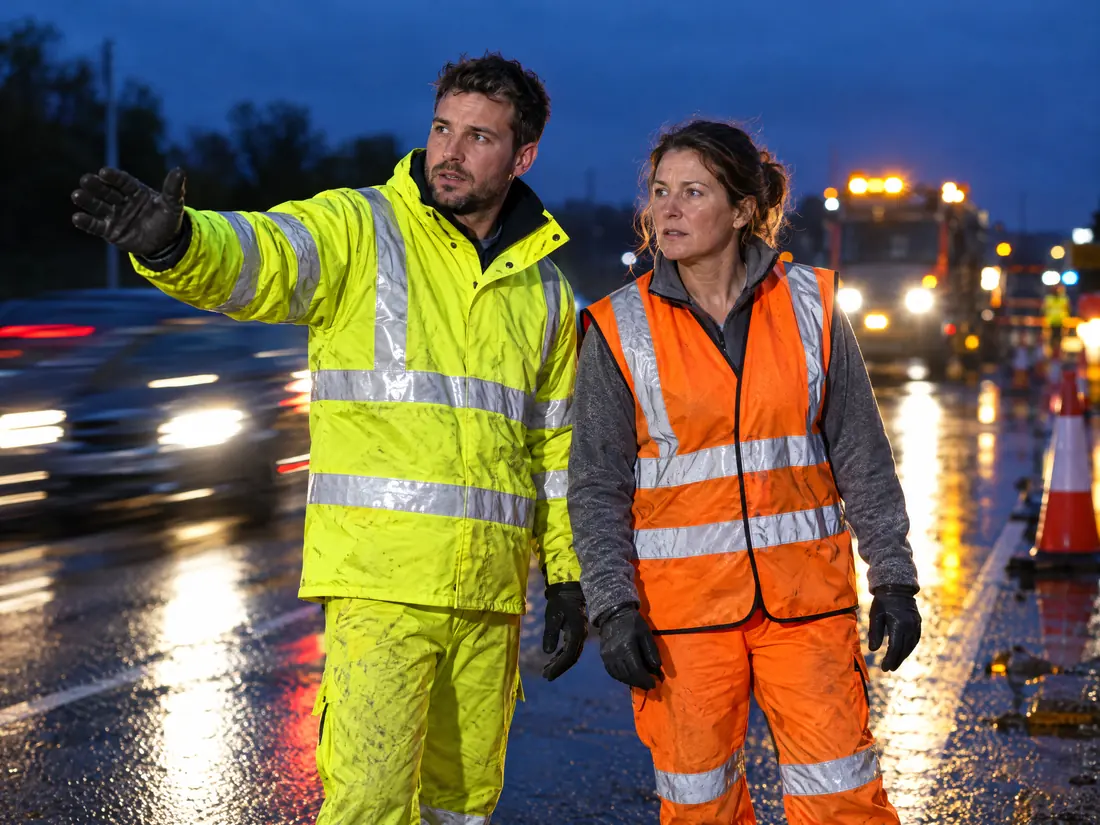
EN 14058 answers a narrower question. Above −5 °C, in a chill room held above freezing or on an open site in winter, how much does one garment that warms part of the body actually help? The introduction names both settings: outdoor work such as construction, and indoor work such as food processing. A padded bodywarmer worn under an apron in a meat cutting room is a typical EN 14058 product.
Here the core measurement is the fabric. Thermal resistance, Rct, is measured on the fabric layers with a sweating guarded hotplate (EN ISO 11092) and is also expressed in m²K/W. The air permeability and water penetration requirements apply only when the manufacturer's instructions claim protection against wind or water. The introduction explains why: in this temperature band, on a building site as much as in food processing, a garment often has no need for watertight or airtight fabric.
If the garment also has an Icler value measured on a manikin, Annex C can translate it into a temperature range, as with EN 342. If it does not, all you know is the resistance of the fabric. Cut, closures, neck and waist openings have not been counted.
The practical line is simple. In a room below −5 °C, an EN 14058 bodywarmer does not replace an EN 342 suit. The reverse causes problems too: issue full EN 342 coveralls to a packing line working above freezing and the team will sweat, which, as explained below, undermines insulation.
Wet conditions and EN 343: a cold suit is not rainwear
EN 342 and EN 14058 point the same way: if wet conditions are expected, the rain standard EN 343 applies. It classifies garments for protection against precipitation, snow, fog and ground humidity by water penetration resistance and water vapour resistance. Water penetration is tested on the outer fabric and on seamed sections.
EN ISO 24232:2025 was published in October 2025 and replaced EN 343:2019; national standards bodies had until April 2026 to adopt it. Since 4 September 2026 the EU list of harmonised standards cites EN ISO 24232:2025 in place of EN 343:2019. Garments labelled to the old standard will stay in stock and in use for a while. The scope is unchanged: precipitation, fog and ground humidity.
It does not rain in a cold store, but things still get wet. Wash-down water, snow and rain carried onto the loading dock and drips from thawing product are the usual sources. There is also a less visible one: when a cold suit comes out into a warm, humid corridor, moisture can condense on it, and for a dock operator going in and out all day that moisture builds up. The introduction to EN 342 gives cold store work as its example of intermittent exposure. In that kind of work, and around 0 °C, how easily vapour passes through the fabric starts to matter; a low Ret supports heat balance and comfort.
Outdoors, when cold comes with rain or sleet, there are two routes. One is a shell marked to EN ISO 24232 or EN 343 worn over the insulating layer. The other is a cold suit whose water penetration has also been tested, in which case check that a WP class is actually marked on the EN 342 label.
Cold store and outdoor cold need different clothing
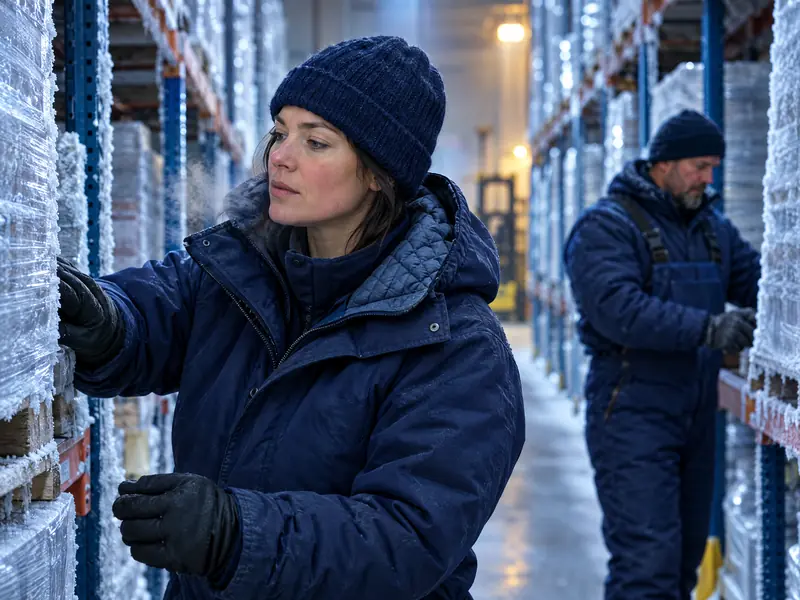
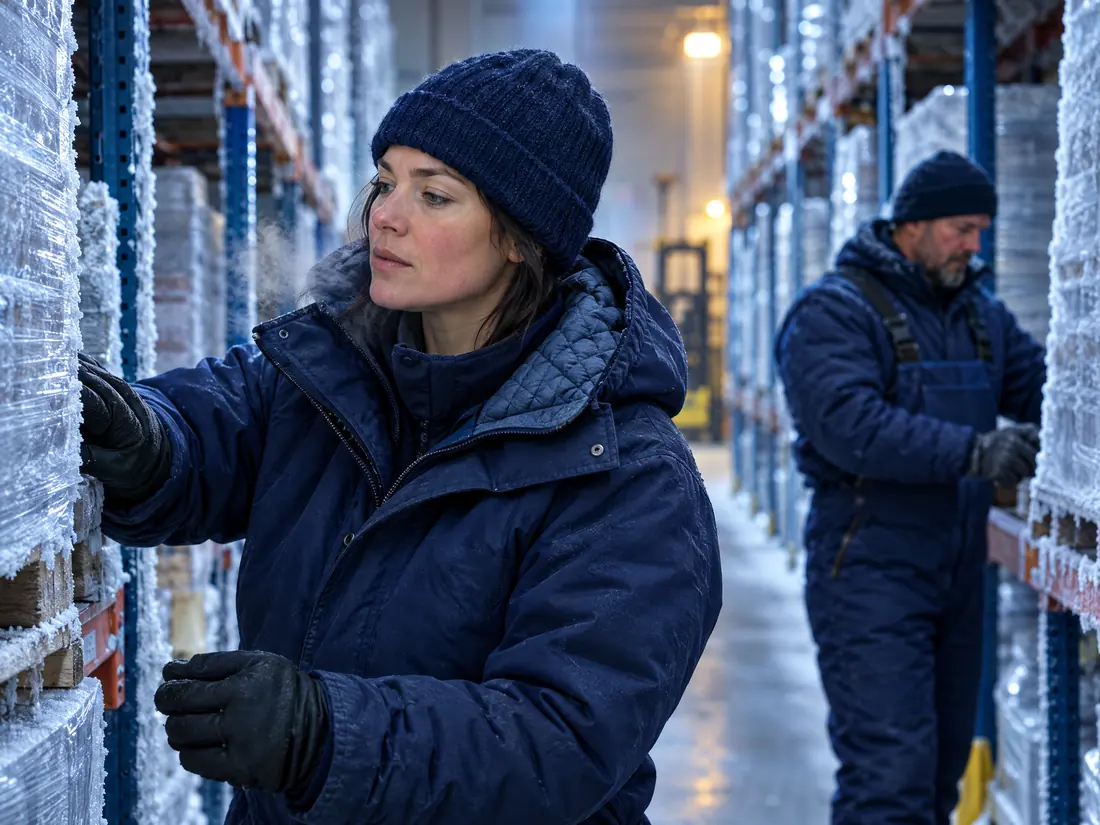
In a freezer store the temperature is steady and there is no wind, yet the air is not entirely still. The Canadian Centre for Occupational Health and Safety (CCOHS) advises that air speed in refrigerated rooms should not exceed 1 m/s, and anyone picking from a rack bay in front of an evaporator fan will feel the draught. The real variable is time. A picker in a −20 °C room may spend hours under the same conditions, while a forklift driver on the dock moves between warm and cold all day and needs clothing that opens and closes quickly.
Outdoors, wind decides. In the wind chill guidance CCOHS reproduces, wet skin in the wind means working the figure out from an air temperature 10 °C below the measured one. A shell that blocks wind and keeps water out matters as much as insulation thickness. For a construction crew working through winter, an EN 14058 padded bodywarmer, an EN ISO 24232 shell and a high-visibility outer layer are planned together.
Turkish regulation lists the two settings separately as well. Annex 3 of the regulation on the use of PPE at work names work in deep-freeze rooms among the jobs that may require protective clothing, and outdoor work in cold, rainy weather under weather-resistant clothing.
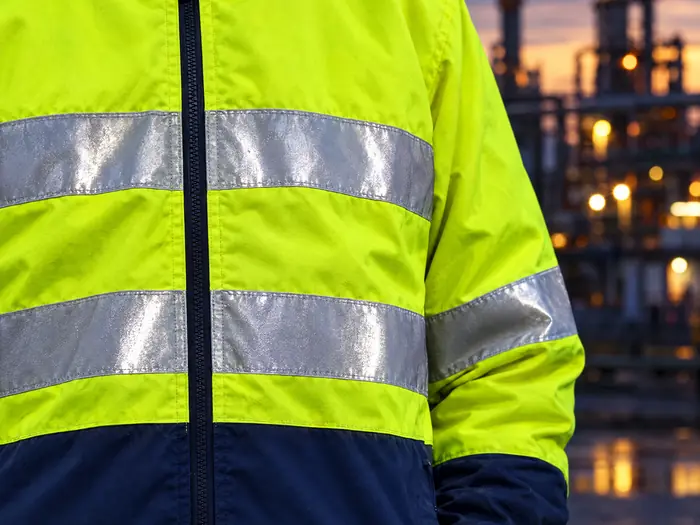
Where forklifts and pallet trucks share the aisles, cold room clothing also has to be visible. High visibility and cold protection can be combined in one garment, but each is tested to its own standard and both should appear on the label. A food plant's cold room adds another condition: clothing must not shed foreign matter into product and has to withstand the site's laundry routine. A washable insulated suit without outer pockets or exposed buttons is therefore cut differently from a warehouse suit.
Let's choose the right product for your team
Tell us the site conditions, quantity and the standard you need; we come back with fabric, model and sample options.
Three layers: base, insulation, shell
Layering works because still air trapped between layers insulates, and because the number of layers gives you control: open one when you warm up, add one during a break. CCOHS notes that several layers protect better than one thick garment and that each outer layer should be larger than the one beneath it. A tight outer layer compresses the insulation underneath and the insulation drops.
Each layer has its own job:
- Base layer: keeps skin dry. Choose fibres that move moisture away from the skin, such as wool, polyester or polypropylene. Cotton gets damp quickly and loses its insulation, whereas wool and synthetics keep some warmth when wet.
- Insulating layer: fleece, a padded jacket and trousers, or the lining of the EN 342 suit itself. What counts is the still air it holds, more than its thickness.
- Shell: blocks wind and outside moisture while letting water vapour from inside escape. Neck, waist and cuffs should be adjustable, and underarm vent zips make a real difference for crews doing heavy work.
Hands and feet: EN 511 gloves and CI-marked footwear
EN 511:2006 covers gloves against convective and contact cold down to −50 °C. In the convective test the glove is fitted to an electrically heated hand, and the power needed to hold the hand at 30–35 °C is measured. The contact test measures thermal resistance when gripping a cold object. For water penetration the glove is immersed up to the wrist line; if no leak shows at the end of the test it scores 1, otherwise 0, and the instructions must warn that the glove may lose insulation when wet. The three digits on the marking read in that order: convective cold, contact cold, water penetration.
Two conditions cap the levels a glove can claim. It must reach at least level 1 for abrasion and tear under EN 388. To claim level 2, 3 or 4 for convective or contact cold it needs at least level 2 for abrasion and tear; otherwise the highest cold level it can report is 1. Gloves designed for use below −30 °C must also pass a fold test at −50 °C without cracking. Multi-layer gloves are tested with all layers together, so pairing a liner with a different outer glove leaves you with a combination the label does not describe.
Gloves or mittens? CCOHS reproduces a rule of thumb for work that does not demand fine finger movement: light work calls for gloves once the air drops below 4 °C, moderate work below −7 °C, and anything below −17 °C calls for mittens. France's occupational safety institute INRS lists bare skin contact with metal surfaces colder than −7 °C among the risk factors. For a picker using a handheld scanner, the usual answer on site is a thin moisture-wicking liner under an outer glove that comes off and goes back on quickly. Buying both as a set tested together keeps the label honest.
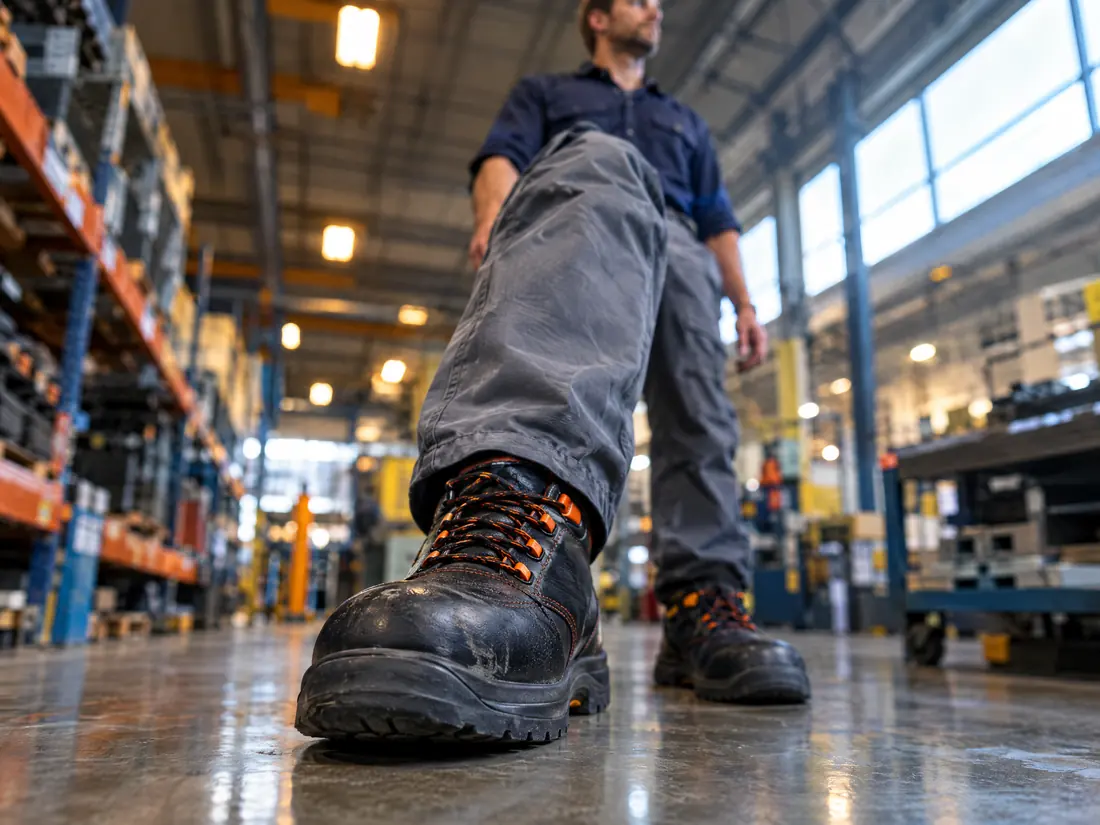
In the EN ISO 20345 family of safety footwear standards, cold insulation of the sole complex is marked CI. Under the foot protection rule of DGUV, Germany's statutory accident insurance, the test puts the shoe in a −17 °C environment with +23 °C inside; after 30 minutes the temperature at the insole surface must not have dropped by more than 10 °C. The same rule says that in cold stores and similar areas the insulation of the sole matters more than that of the upper. Polyurethane outsoles insulate well, while rubber and PVC soles need extra measures. Steel toecaps and metal penetration-resistant inserts do not make the inside of the shoe colder.
Socks and sizing belong to the same system. Try boots on with the socks that will be worn at work. If two pairs are worn, the outer pair should be a size larger. Socks that are too thick make the boot tight, compress the insulation and slow blood flow. For staff who stand on cold floors for long periods, Britain's Health and Safety Executive (HSE) suggests insulated flooring or footwear made for the purpose.
| Level | Convective cold: thermal insulation ITR (m²K/W) | Contact cold: thermal resistance R (m²K/W) |
|---|---|---|
| 1 | 0.10 ≤ ITR < 0.15 | 0.025 ≤ R < 0.050 |
| 2 | 0.15 ≤ ITR < 0.22 | 0.050 ≤ R < 0.100 |
| 3 | 0.22 ≤ ITR < 0.30 | 0.100 ≤ R < 0.150 |
| 4 | ITR ≥ 0.30 | R ≥ 0.150 |
Sweat, breaks and exposure time
The most common mistake in the cold is dressing too warm. Someone lifting cases sweats, the sweat soaks the base layer, the wet layer loses insulation fast, and the first idle minute brings a chill. The introduction to EN 342 is direct about this: in continuous cold work, sweat is the thing to prevent, since the moisture a garment takes up eats into its insulation over the shift. Its remedy is insulation matched to the job rather than the most insulation on offer, and clothing the wearer can adjust rather than a closed, fixed ensemble. Opening vents and fastenings clears heat and moisture faster than waiting for them to diffuse through the layers.
The order in which you shed layers is a useful habit. CCOHS suggests, to prevent sweating: gloves first (unless you need them against snow or ice), then hat and scarf, then open the jacket at waist and wrists, and finally remove outer layers. As you cool down, reverse the order. A note on headwear: under a hard hat, a knit cap or liner cuts heat loss, but pick one the helmet's manufacturer has approved so the helmet still protects as designed. Dirty clothing is less warm too, because dirt fills the air spaces between fibres.
There is no single figure for breaks or continuous time inside that suits every site. Room temperature, air speed, workload and the insulation of the clothing worn have to be assessed together. EN ISO 11079 does this calculation: it works out the clothing insulation required for the environment and workload (IREQ) and, where the clothing worn falls short, a permissible exposure time. INRS advises bringing in specialist support, since the assessment depends on measurement and interpretation.
In Turkey the framework is the risk assessment. The regulation on the use of PPE at work requires the conditions of use, and in particular the duration of use, to be set according to the degree of risk, frequency of exposure, the features of each workplace and the performance of the equipment. It also requires that where several items of PPE are worn together, they are chosen so that one does not reduce the protection of another. A hat under a hard hat, or a liner inside an outer glove, is that rule in everyday form.
What the agencies recommend in practice is broadly the same. HSE's list for cold work covers suitable protective clothing, breaks long enough to warm up and get a hot drink in a heated area, flexible working patterns or job rotation to limit exposure, and processes designed to cut the time spent in cold areas. INRS asks for a heated but not overheated rest room where clothes can dry and spares can be kept, extra recovery time after exposure to very low temperatures, heated floors and insulated seating for static jobs such as labelling, doors that open from the inside and an audible and visual alarm against being shut in. CCOHS advises opening the neck, waist and cuffs, or taking off the outer layer, in the rest area, so sweat evaporates and the worker goes back in dry.
Environments with effects comparable to −50 °C or below are a separate class. The EU PPE Regulation (2016/425) places equipment designed for that level of cold in Category III, its highest risk category. The European Commission's guidelines define the criterion as conditions in which exposed skin can freeze in under two minutes. −50 °C here means calm air with wind of no more than 5 km/h; in stronger wind the same effect arrives at milder temperatures. Turkey's PPE Regulation was drafted with this EU regulation in view.
What to put in the quotation request and specification
“Freezer jacket, 50 pieces” is not a specification. To propose the right suit a supplier needs four facts: the room temperature, how long one person stays inside without a break, how much they move (walking picks or a fixed bench) and where moisture comes from. Those four facts set the target Icler for an EN 342 suit and whether a WP class is needed, and they show whether an EN 14058 garment is enough for a chill room.
When you ask Formasan for a quotation, adding headcount, size distribution and what will be worn underneath speeds things up, because the outer layer is sized around the base and insulating layers. In a food plant the wash temperature, and in a warehouse the need for high visibility around forklift traffic, will change the pattern as well.
Plan the suit, gloves and footwear as one system. Formasan manufactures the cold-environment suits and thermal layers, and supplies the gloves and safety footwear. For gloves, write the minimum convective level and the water digit into the specification; for footwear, the class code and the CI marking, for example S3 CI.
At delivery, check the label: standard number and year (EN 342:2017, for instance), the Icler value, the classes, the CE mark and instructions in the user's language. The instructions include washing guidance. Because insulation can fall with laundering, give those instructions to the laundry in writing, and because a wet suit may not dry between shifts, plan a spare set per person.
Standards and regulations referenced
- EN 342:2017
- EN 14058:2017+A1:2023
- EN 343:2019
- EN ISO 24232:2025
- EN 511:2006
- EN 388:2016+A1:2018
- EN ISO 20345:2022
- EN ISO 11079
- EN ISO 9920:2007
- EN ISO 15831:2004
- EN ISO 11092:2014
- EN ISO 9237:1995
- Regulation (EU) 2016/425
- Commission Implementing Decision (EU) 2026/1279
- Kişisel Koruyucu Donanım Yönetmeliği (RG 01.05.2019, sayı 30761)
- Kişisel Koruyucu Donanımların İşyerlerinde Kullanılması Hakkında Yönetmelik (RG 02.07.2013, sayı 28695)