The fall arrest system and the standards behind it
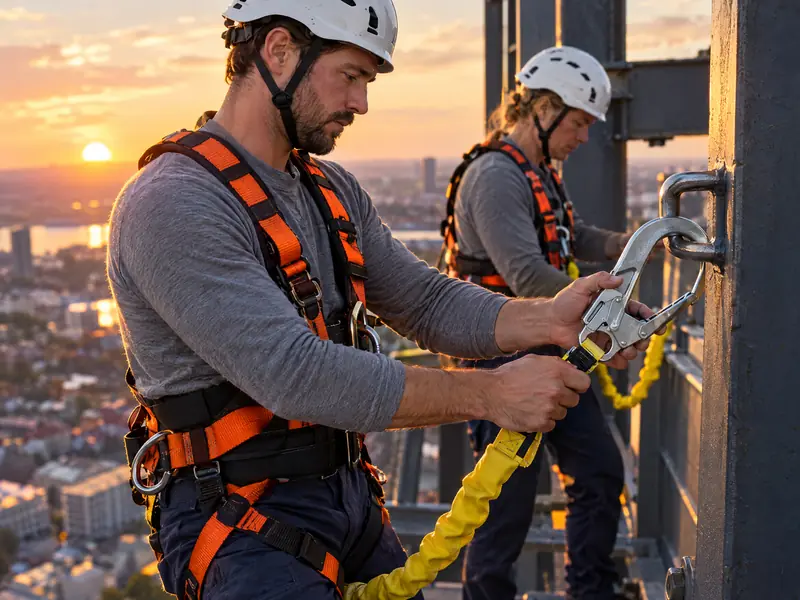
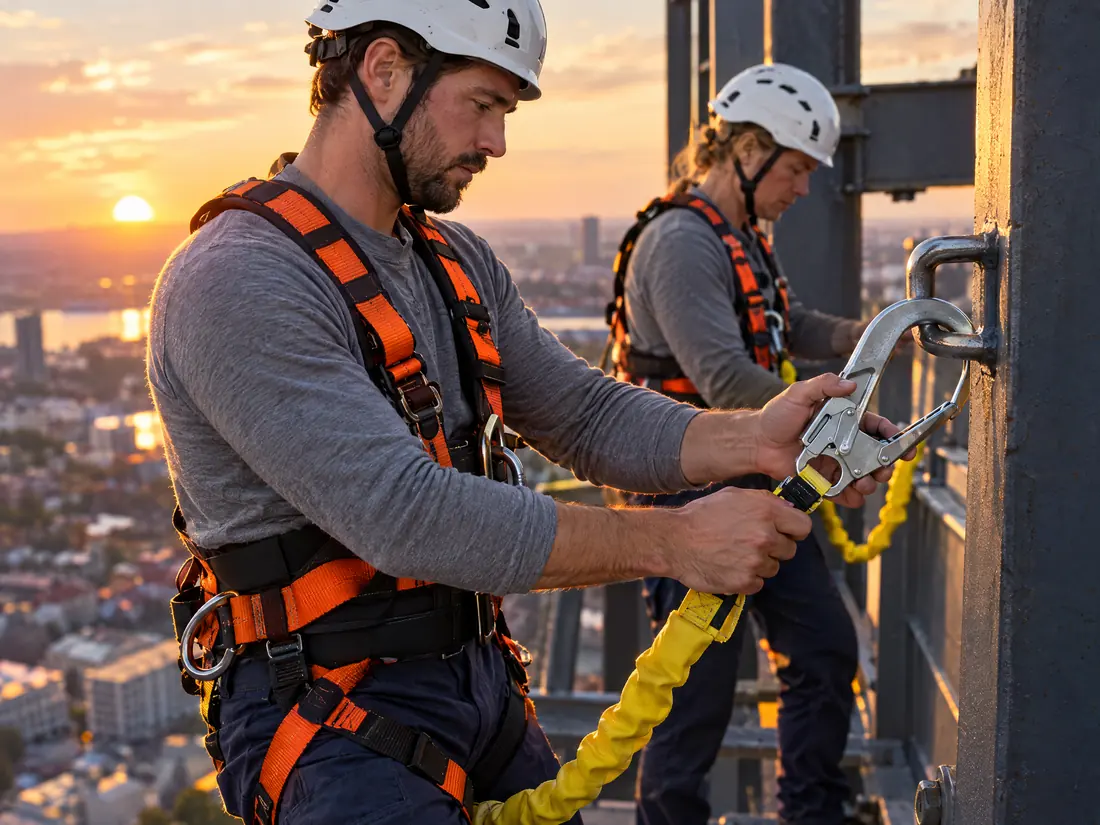
Every fall arrest system has the same three elements: an anchor that can take the load, a full body harness to hold the body, and a connecting subsystem between the two. France's occupational safety institute INRS adds the key condition: the force reaching the body must be limited to 600 daN, or 6 kN. An energy absorbing lanyard, a retractable or a guided type fall arrester does that job.
Regulation (EU) 2016/425 puts falling from a height in Category III, the class kept for risks that can cause death or irreversible damage to health. That is why a harness, lanyard or connector carries, next to its CE mark, the four-digit number of the notified body that oversees its production. EN 363:2018 describes how components are assembled into systems and gives examples of each type: restraint, work positioning, rope access, fall arrest and rescue.
Two rows in the table need a second look, as older catalogues quote earlier editions. The EU presumption of conformity under EN 360:2002 ended on 8 April 2026; EN 360:2023 now applies. EN 353-2:2002 loses its presumption on 16 November 2026 in favour of EN 353-2:2024. And EN 795:2012 carries a warning in the EU list: type A anchors that need structural fixings, type C flexible horizontal lines and type D rigid horizontal lines are not considered PPE, so the standard gives them no presumption of conformity. Type B devices, which need no fixings, and deadweight type E anchors are outside that warning.
In Turkey, the Construction Work Health and Safety Regulation (Official Gazette 05.10.2013, No. 28786) treats any work with a difference in level where a fall could cause injury as work at height, with no metre threshold. Its Annex 4 puts guardrails, platforms, scaffolds, safety nets and other collective protection first. Full body harness systems on suitable anchor points or lifelines come in where collective protection cannot remove the risk, under the supervision of a competent person appointed by the employer.
| Standard | Scope | On site | Key value / note |
|---|---|---|---|
| EN 361:2002 | Full body harnesses | Safety harness; attachment points marked “A” | 100 kg torso dummy, 4 m drop; held within 50° of vertical; static 15 kN (upward) and 10 kN (downward) |
| EN 355:2002 | Energy absorbers | Tear-webbing pack on the lanyard | Free fall of twice the lanyard length: max 6 kN; deployment max 1.75 m; absorber, lanyard and connectors together max 2 m |
| EN 354:2010 | Lanyards | Single, twin (Y), fixed or adjustable | Static 22 kN (non-metallic), 15 kN (metal); 4 m drop test for adjustable lanyards |
| EN 358:2018 | Belts and lanyards for work positioning or restraint | Positioning belt, pole strap | 1 m drop test; static 15 kN; does not arrest falls |
| EN 360:2023 | Retractable type fall arresters | Self-retracting lifeline; single and twin | EU presumption for the 2002 edition ended 8 April 2026 |
| EN 353-1:2014+A1:2017 / EN 353-2:2024 | Guided type fall arresters | Ladder rail (rigid line) or vertical rope (flexible line) | EN 353-2:2002 presumption ends 16 November 2026 |
| EN 362:2004 | Connectors | Karabiners, scaffold hooks, screw links; classes B, M, T, A, Q | Major axis, gate locked: 20 kN (class Q 25 kN); minor axis: B 7 kN, M 15 kN |
| EN 795:2012 | Anchor devices, types A–E | Bolt-fixed anchor, beam clamp, horizontal line, rail, deadweight anchor | Static 12 kN; 18 kN with non-metallic load-bearing parts; +1 kN per extra user under CEN/TS 16415 |
| EN 363:2018 | Personal fall protection systems | Rules for combining components | Gives examples of restraint, positioning, rope access, fall arrest and rescue systems |
| EN 365:2004 | Instructions, maintenance, periodic examination, marking | Product record card, inspection log | Periodic examination at least every 12 months |
Parts of a full body harness
EN 361 splits harness webbing into two kinds. Primary straps carry the body during and after an arrest and must be at least 40 mm wide. Secondary straps carry no load; they keep the primaries in position and must be at least 20 mm wide. Stitching is in a contrasting colour so that a cut or rubbed seam stands out at inspection.
Some harnesses add an EN 358 waist belt with two side D-rings. Those rings are for positioning, such as leaning back on a pole with both hands free, and a fall arrest lanyard never goes on them. If a point is not marked “A”, it is not a fall arrest attachment point, however solid it looks.
The parts of a typical EN 361 harness:
- Shoulder straps, running from the back over to the chest; height adjustment usually sits here.
- Leg (thigh) straps, which spread the arrest load into the legs and close with pass-through or quick-connect buckles.
- Subpelvic strap, passing under the buttocks; a suspended worker effectively sits in it.
- Chest strap, joining the two shoulder straps at mid-chest.
- Dorsal attachment point between the shoulder blades, marked “A”, the normal connection for a fall arrest lanyard.
- Sternal attachment point: either a single ring marked “A” or two loops marked “A/2” that must always be used together. Clipping into only one “A/2” loop is a wrong connection.
- Buckles and keepers: a buckle must not open or let the strap slip on its own, and the loose strap end goes into its keeper.
- Label: manufacturer, model, batch number, EN 361 with year, CE mark with the four-digit notified body number, and the read-the-instructions pictogram.
How to put on and adjust a harness
Size the harness for the thickest clothing worn on site. One adjusted over a winter jacket and fleece hangs loose over a work shirt in spring, so it is re-adjusted when the season changes. Nothing hard, such as a phone or tape measure, should sit in a pocket under a strap, because in an arrest the load concentrates there.
Loose leg straps change how the harness behaves in a fall. In a fall the harness rides up, the load moves from the thighs to the groin, and the dorsal ring climbs towards the back of the head. The EN 361 drop test requires the dummy to come to rest within 50° of vertical, and that result assumes a harness worn and tightened as instructed.
Which attachment point is used for what is stated in the harness instructions. Fall arrest with an energy absorbing lanyard normally uses the dorsal point. On many models the sternal point is meant for guided type fall arresters on ladder rails or vertical ropes, and for rescue.
Check it by hand and eye first (see the inspection section), then:
- Hold the harness by the dorsal ring and give it a shake so the straps drop into place and any twists show.
- Slip the shoulder straps on like a waistcoat. The dorsal ring should sit between the shoulder blades, in the middle of the back.
- Bring the leg straps through and buckle them without crossing them over. Do not trust the click; pull the strap and watch it hold.
- Close the chest strap at mid-chest.
- Tighten the leg straps first, then the shoulder straps. Tuck loose ends into the keepers, since a flapping end can snag.
- Ask a colleague to check the dorsal ring position and that no strap is twisted.
What a lanyard does, and how long a fall arrest lanyard can be
A lanyard is the short length of webbing, rope or chain that links the harness attachment point to the anchor. The same word covers three different jobs. An energy absorbing lanyard arrests falls (EN 354 with EN 355). A lanyard without an absorber is for restraint only: it stops the worker reaching an edge at all. A work positioning lanyard (EN 358) goes around a pole or beam and holds the worker in place.
For fall arrest, the overall length, energy absorber, terminations and connectors included, may not exceed 2 m. On a fixed anchor point the lanyard must include an energy absorber. Most absorbers are folded, stitched webbing that tears progressively in a fall. In the EN 355 test a solid mass of at least 100 kg falls twice the lanyard length. The arrest force may not exceed 6 kN and the absorber may not deploy more than 1.75 m.
How far the absorber opens depends on the fall factor, the ratio of free fall distance to lanyard length. With the anchor overhead and the lanyard taut, the fall factor is close to zero. With the anchor level with the dorsal ring it is 1, and as the anchor drops towards foot level it approaches 2. On a 2 m lanyard, a fall factor of 2 means 4 m of free fall before the absorber starts working. One EN 355 certified absorber lists its deployment as 0 cm, 90 cm and 160 cm at fall factors 0, 1 and 2. A higher anchor means less load on the body and less clearance.
If a worker with tools and clothing weighs more than the 100 kg test mass, use the manufacturer's figures for higher masses, and if the data sheet has none, ask the manufacturer in writing.
Wrapping a lanyard round a beam and clipping it back onto itself presses the webbing edge against the steel. Britain's Health and Safety Executive (HSE) notes that a 1 mm edge cut can reduce a webbing lanyard's strength by 5 to 40% depending on the make, and cites a lanyard choke-hitched around steelwork as one example. Knots weaken a lanyard too; any knot the manufacturer did not intend counts as a defect.
Fall clearance calculation, step by step
Fall clearance is the free height needed below the worker's feet once the fall has stopped. It is measured down from the anchor, and the fall clearance formula has four parts: lanyard length, energy absorber deployment, the distance from the dorsal ring to the soles of the feet, and a safety margin. Manufacturers' data sheets typically take 1.5 m for the ring-to-feet distance of an average user and 1 m for the margin.
Take the worst case the standards allow. The 2 m lanyard goes taut and the absorber opens by the full 1.75 m that EN 355 permits, so the dorsal ring ends up 3.75 m below the anchor. The feet hang 1.5 m below that, and the 1 m margin goes underneath: the system needs 6.25 m of clear space below the anchor.
The last two rows of the table need care. With the absorber fully deployed, clearance below the anchor is the same wherever the anchor sits; what changes is how much of it lies below the surface you stand on. With the anchor at foot level, all 6.25 m must be below the working surface. At dorsal ring height, 4.75 m is enough. On a platform 4 m above the ground neither works. Ireland's Health and Safety Authority (HSA) notes that lanyards are rarely suitable below four metres; there the anchor goes overhead, a retractable is used, or the job moves to restraint.
A real product may need less than the worst case, because the absorber opens less at lower fall factors. One energy absorber tested with 100 kg lists the minimum clearance below the anchor for a 2 m lanyard as 4.5 m, 5.4 m and 6.1 m at fall factors 0, 1 and 2. Use the product's own clearance chart where there is one. Where there is not, use the calculation with the EN limits.
Three situations add to the figure. A flexible horizontal lifeline (EN 795 type C) sags when it catches a fall, and that sag, from the lifeline maker's data, is added. Working off to one side of the anchor sets up a pendulum swing towards a column or wall; INRS flags this especially for retractables used while moving along an edge. And in a fall from a platform the lanyard loads over the edge, so choose a product tested for edge use or fit edge protection, and get the edge-fall clearance from the manufacturer.
| Step | Item | Value | Basis |
|---|---|---|---|
| 1 | Lanyard length (including absorber and connectors) | 2.00 m | EN 355 upper limit |
| 2 | Energy absorber deployment | 1.75 m | EN 355 upper limit |
| 3 | Dorsal ring to soles of the feet | 1.50 m | Average user in manufacturers' data sheets |
| 4 | Safety margin | 1.00 m | Margin used in manufacturers' data sheets |
| 5 | Clearance required below the anchor | 6.25 m | 1 + 2 + 3 + 4 |
| 6 | Anchor at foot level: required below the working surface | 6.25 m | Anchor level with the surface |
| 7 | Anchor at dorsal ring height: required below the working surface | 4.75 m | 6.25 − 1.50 |
Let's choose the right product for your team
Tell us the site conditions, quantity and the standard you need; we come back with fabric, model and sample options.
Single and twin (Y) lanyards
With a single lanyard, a worker who unclips to get past an obstruction is unprotected until they clip in again. A twin lanyard has two legs joined at one point on the harness, hence the name Y lanyard. Passing a scaffold standard, a splice plate on steelwork or a crossarm on a pole, the free leg goes on beyond the obstruction first and only then is the other leg released, so the worker is never without an anchor.
Where the unused leg goes matters too. One manufacturer's instructions warn that clipping it back onto the harness can stop the absorber opening fully in a fall; the only exception is a parking point that some harnesses have for this purpose. Clipping the spare leg to the sternal ring, a gear loop or the waist belt is therefore wrong.
Each leg of a twin lanyard is held to the same 2 m limit, and clearance is worked out as for a single lanyard.
When you ask Formasan for a quotation on work at height equipment, a few facts get the right product first time: users' weight range with tools, the size spread, attachment points needed (dorsal only, dorsal and sternal, or with a positioning belt), lanyard type (single or twin, fixed or adjustable), the connector's gate opening (a wide-opening hook for scaffold tube, say) and the lowest working height, which shows at ordering stage whether the clearance works.
Work positioning, restraint and fall arrest compared
Restraint stops the fall from happening at all: the lanyard is set so the worker cannot reach the edge they could fall from. With no fall there is no clearance to calculate, but the lanyard length is checked against every fall point (roof edge, floor opening, light well), and it changes whenever the anchor moves.
Work positioning holds the worker on a tensioned strap so both hands are free. It is used on poles, trees, column heads and formwork. EN 358 tests the belt and lanyard with a 1 m drop, while a fall arrest harness is tested with a 4 m drop, a gap that shows positioning equipment is not designed for a long free fall. Irish regulations also require a work positioning system to include a backup system for preventing or arresting a fall.
Fall arrest stops a fall that has already started and needs clearance underneath. INRS states the reverse rule as well: a fall arrest system is for arresting falls only, not for hanging in while working or holding on while climbing. For a line crew on a pole, the correct set-up is a full body harness with an EN 358 waist belt, a positioning lanyard round the pole and a separate fall arrest connection.
Pre-use checks, inspection frequency and lifespan
EN 365:2004 calls for periodic examination at least every twelve months. HSE's regime for webbing lanyards with energy absorbers is tighter: a detailed inspection at least every six months, and at least every three months for lanyards in frequent use. The shorter interval matters most in arduous work: demolition, steel erection, scaffolding, or steel towers full of edges and protrusions. The inspector needs real authority to discard kit, and every item carries a permanent ID linked to its records.
A lanyard that has arrested a fall is never used again. HSE says it is withdrawn immediately and destroyed or returned to the manufacturer. Equipment with an illegible identity, no evidence of a competent person's inspection in the last six months, or any doubt about its safety is also taken out of use until a detailed inspection decides its fate.
Service life is set by the manufacturer, and the figures vary. One manufacturer limits its adjustable energy absorbing lanyard to 5 years from first issue; another gives its twin energy absorbing lanyard a 10-year lifespan. HSA advises disposal after any lifespan date the manufacturer gives. The research HSE draws on found no clear age at which a webbing lanyard stops being safe, so one well inside its lifespan with a cut, heat damage or chemical attack is retired that day.
Turkey's Construction Work Health and Safety Regulation requires regular checks and maintenance of work at height equipment and bars unsuitable equipment, but sets no interval. Frequency follows the risk assessment and the manufacturer's instructions; the intervals above are a sound starting point.
HSE lists the defects to look for in specific terms:
- Edge cuts of 1 mm or more
- Wear on the face of the webbing or at the loops, worst when it is concentrated in one spot
- Cut or worn stitching
- Any knot the manufacturer did not design in
- Chemical attack: a flaking surface, soft patches, a change of colour
- Heat or friction damage: shiny, glazed fibres that are stiffer than the rest
- An energy absorber that has started to open, such as a short tail of tear webbing showing
- Dirt, grit or sand worked into the webbing, wearing it from inside and out
- Deformed or damaged karabiners, screw links and scaffold hooks
- UV damage: hard to spot; faded colour and a powdery surface can give it away
| Check | Frequency | Done by | How |
|---|---|---|---|
| Pre-use check | Before every use | User | By hand and eye in good light; the whole strap passed through the hands; takes a few minutes |
| Detailed inspection | At least every 6 months; at least every 3 months for lanyards in frequent use | Competent person | Recorded against the unique ID |
| Interim inspection | During temporary harsh conditions such as paint, chemicals or grit blasting | Competent person | As the risk assessment requires; recorded |
| Periodic examination (EN 365) | At least every 12 months | Competent person | To the manufacturer's instructions; record kept |
Suspension trauma and the rescue plan
An arrested fall is not the end of the incident. In a worker hanging motionless in a harness, blood pools in the legs and less of it reaches the brain, heart and kidneys. HSA puts the time to loss of consciousness at roughly six minutes to two hours, with death possible within a few minutes in the worst case. A US Occupational Safety and Health Administration (OSHA) bulletin cites research showing unconsciousness and death can follow in under 30 minutes.
A conscious worker waiting for rescue should keep moving their legs. OSHA says pumping the leg muscles reduces pooling and that footholds can relieve pressure and delay symptoms. Anyone rescued is seen by a health professional even without symptoms, because delayed effects such as kidney failure cannot be judged at the scene.
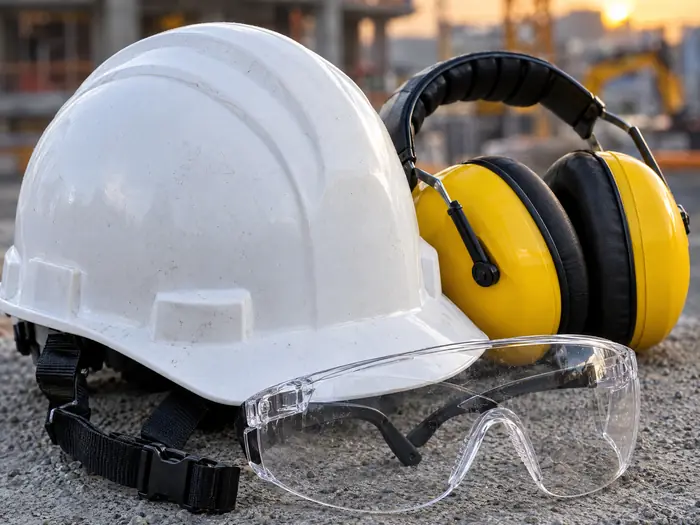
Head protection belongs in the same preparation, since a worker swinging on a lanyard can strike the structure or the edge. HSA asks that helmets worn with personal fall protection systems have chin straps that stop them coming off.
What shortens time in suspension is a rescue plan made before work starts. Turkey's construction regulation requires falls from height to be covered in the emergency plan, and HSA cautions that the emergency services may not be able to reach a suspended worker in time, so the site cannot rely on them. The plan should answer:
- Who reaches a fallen worker, and in how many minutes?
- With what: rescue kit, descent device, mobile elevating work platform, ladder?
- Where does the rescuer anchor, and how is their own fall risk controlled?
- Who gives first aid once the worker is down, and how is medical help called?
- When was the plan last tested in a drill?
Standards and regulations referenced
- EN 361:2002
- EN 355:2002
- EN 354:2010
- EN 358:2018
- EN 360:2023
- EN 353-1:2014+A1:2017
- EN 353-2:2024
- EN 362:2004
- EN 795:2012
- CEN/TS 16415:2013
- EN 363:2018
- EN 365:2004
- Regulation (EU) 2016/425
- Commission Implementing Decision (EU) 2024/2599
- Commission Implementing Decision (EU) 2026/1279
- HSE INDG367 Inspecting fall arrest equipment made from webbing or rope
- HSA Guide to the General Application Regulations 2007, Part 4: Work at Height
- INRS ED 6110 Prévention des risques de chutes de hauteur (2019)
- OSHA SHIB 03-24-2004 Suspension Trauma/Orthostatic Intolerance
- Yapı İşlerinde İş Sağlığı ve Güvenliği Yönetmeliği (RG 05.10.2013, 28786)