
Same yarn, two different jobs: ignition or component damage
Everyone builds up charge. In the typical values published by the EOS/ESD Association, a person walking across carpet reaches up to 35,000 V at 10–25% relative humidity; at 65–90% the same walk stays around 1,500 V. That is why complaints rise in winter and in dry, air-conditioned halls. The real difference shows up in where the charge goes next.
In a refinery, a spray booth or a solvent filling line, the discharge is a spark, and it can ignite a mixture of gas, vapour or dust in the air. What needs protecting is the worker and the plant. The garment is personal protective equipment, and its reference standard is EN 1149-5.
On a circuit board assembly line the same discharge hurts nobody. According to DGUV Regel 112-191 (December 2025), the footwear rule of the German statutory accident insurance, people only feel a discharge from roughly 3,000 to 3,500 V, while some electronic components can be damaged at 30 V. An operator can leave a control unit primed for an early field failure without noticing anything at all. Here the component is what needs protecting. The garment is one element of the ESD control programme described in EN 61340-5-1, and ESD function is not treated as part of personal protective equipment.
Both worlds weave conductive fibre into the cloth as a grid. A fabric data sheet will show figures such as 99% polyester with 1% antistatic fibre on a 7.5 mm grid. That is where the similarity ends: test methods, thresholds and earthing requirements differ. A fabric can pass the tests of both standards, in which case its documents list each standard separately.
| Aspect | Antistatic (EN 1149-5:2018) | ESD (EN IEC 61340-5-1:2024) |
|---|---|---|
| Protects | Worker and plant: no spark that ignites an explosive atmosphere | Electronic components: parts withstanding 100 V HBM and 200 V CDM or more |
| Where | Areas classified for explosive atmospheres, minimum ignition energy ≥ 0.016 mJ | ESD protected area (EPA); flammable liquids, gases and powders excluded |
| Fabric or garment criterion | EN 1149-1: surface resistance ≤ 2.5 × 10⁹ Ω, or EN 1149-3: t50 < 4 s or S > 0.2 | EN IEC 61340-4-9: point-to-point, groundable point and system resistance |
| Earthing | Person-to-earth resistance < 10⁸ Ω (via footwear and floor) | Wrist strap or footwear-flooring system; ESD footwear ≤ 10⁸ Ω |
| Regulatory status | Personal protective equipment, linked to Regulation (EU) 2016/425 | ESD control programme; not PPE |
| Marking | ISO 7000-2415 pictogram | ESD protective symbol |
What EN 1149-5:2018 asks for
The current text of EN 1149-5 dates from 2018. CEN approved it on 30 April 2018 and it replaced the 2008 edition. It sets material and design requirements for electrostatic dissipative protective clothing, hoods and caps included, for explosive atmospheres whose minimum ignition energy is 0.016 mJ or higher. Turkey is among the CEN members required to adopt it as a national standard.
The fabric can qualify in one of two ways. Under EN 1149-1, the surface resistance of at least one face must not exceed 2.5 × 10⁹ Ω. Under method 2 of EN 1149-3, induction charging, the half-decay time t50 must be below 4 seconds or the shielding factor S above 0.2. The surface method does not apply to fabrics whose conductivity sits in the core of the fibre, so those are assessed by charge decay.
When reading a test report, check which method was used before anything else. A one-line statement that a garment “complies with EN 1149-5” is not the same thing as a report that gives the method, the sample and the measured value. Among the normative references are EN ISO 13688 for general garment requirements and EN 60079-32-2, the test standard for electrostatic hazards in explosive atmospheres.
Part 4 of the series, a test on the complete garment, is still listed as under development in the 2018 text. The fabric is measured in a laboratory; whether the garment works as a whole depends on its design and on how it is worn.
| Part | What it measures | Role in EN 1149-5 |
|---|---|---|
| EN 1149-1:2006 | Surface resistance (surface resistivity test method) | ≤ 2.5 × 10⁹ Ω on at least one face; not applicable to core-conductive fibres |
| EN 1149-2 | Resistance through the material (vertical resistance) | Not among the normative references of EN 1149-5 |
| EN 1149-3:2004 | Charge decay; method 2 is induction charging | t50 < 4 s or S > 0.2 |
| EN 1149-4 | Complete garment test | Under development according to the 2018 text |
| EN 1149-5:2018 | Material performance and design requirements | Fabric passes one of the two methods; design and user information requirements apply |
Without earthing the garment does nothing
EN 1149-5 does not describe a garment in isolation. It treats it as part of a “total earthed system”, in which people and every other conductor are bonded to earth through less than 10⁸ Ω. Charge collected by the garment travels through the body to the feet and from the footwear into the floor. If one link in that chain insulates, the charge stays on the person and the fabric's test result means nothing.
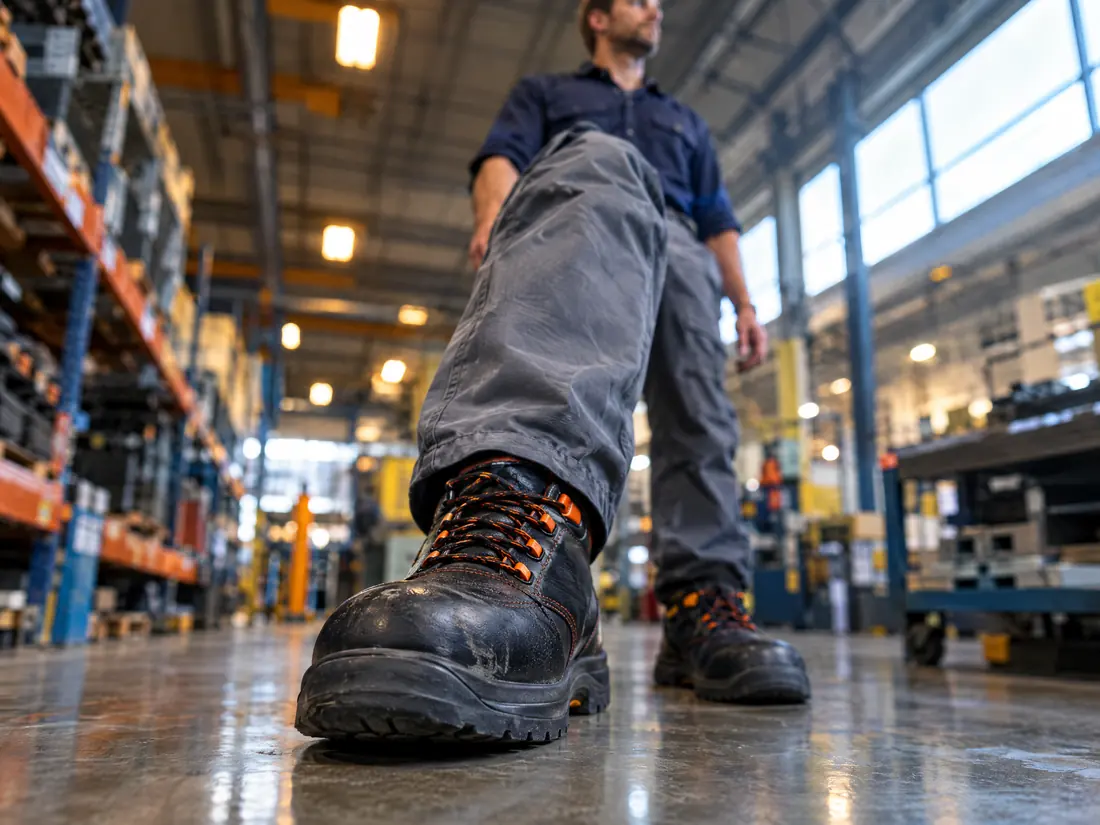
In practice the footwear and the floor make that connection. DGUV Regel 112-191 only accepts a floor in an explosive area as dissipative when its resistance to earth is below 10⁸ Ω. The same rule carries a warning: antistatic (A) footwear that measures between 10⁸ and 10⁹ Ω does not meet the target of TRGS 727, the German technical rule on electrostatic ignition hazards. Seeing an A on the label is not enough; before work starts in the hazardous area, a measurement should show whether that shoe is suitable for the job. Once the wearer loses contact with the floor, as in work at height, rope access or when overshoes are worn, separate measures are needed to keep the person from charging up.
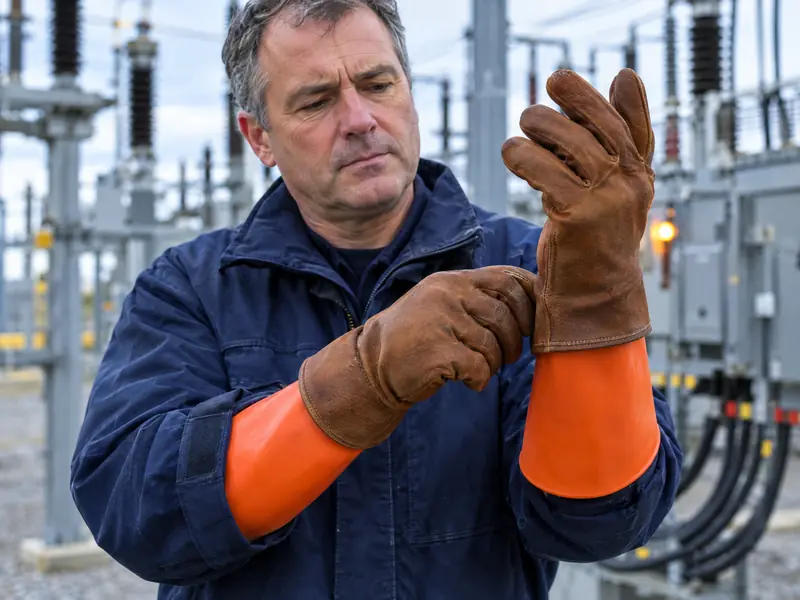
Some things sit outside the standard. Gloves and footwear that are separate from the garment are not assessed under EN 1149-5. Additional equipment in contact with the clothing, a breathing apparatus for instance, is not presumed to be earthed and needs its own arrangement. Protection against mains voltage is also out of scope.
The rules that manufacturers put in their user information turn into four habits on site:
- The garment stays closed in use: buttons done up, zip or ties fastened.
- It is not opened or taken off in a flammable or explosive atmosphere, nor while such substances are being handled.
- Whether the wearer bends, reaches or climbs, the outer garment keeps covering any non-conforming layer beneath it. A fleece showing under a jacket that rides up as the wearer bends is where this rule breaks most often.
- Parts of the body the garment leaves uncovered need protection of their own.
ATEX zones and oxygen-enriched atmospheres
Whether a given area calls for antistatic clothing is decided by workplace legislation, not by the garment standard. In the EU that is Directive 1999/92/EC of 16 December 1999. Its Turkish counterpart is the regulation on protecting workers from the hazards of explosive atmospheres, published in Official Gazette no. 28633 on 30 April 2013. It requires the employer to classify places where an explosive atmosphere may form into zones (article 9) and to record this in an explosion protection document (article 10).
Zones 0, 1 and 2 cover gas, vapour and mist; zones 20, 21 and 22 cover combustible dust. In zones 0 and 20 the explosive atmosphere is there continuously, for long periods or frequently. In zones 1 and 21 it can be expected now and then in normal operation. In zones 2 and 22 it is not expected in normal operation and, if it does form, does not last long. Point 2.3 of Annex II makes the employer provide suitable working clothes whose materials will not produce an electrostatic discharge able to ignite the atmosphere.
The risk assessment is what links a zone to a garment. In Germany, DGUV Regel 112-191 spells it out on the basis of TRGS 727: in zones 0, 1 and 20, footwear must keep the person's resistance to earth at no more than 10⁸ Ω, and the same applies in zone 21 for dusts with a minimum ignition energy below 10 mJ. The same source notes that people do not normally work in zones 0 or 20.
EN 1149-5 has its own limit. Its scope warns that the material and design requirements may fall short in oxygen-enriched flammable atmospheres and points to CEN/CLC/TR 16832:2015 for more detail. Manufacturers' user information makes use in such atmospheres subject to approval by the responsible safety engineer. Maintenance on an oxygen line or oxy-fuel cutting inside an enclosed space therefore needs its own assessment.
ESD garments: EN 61340-5-1 and the EPA
EN 61340-5-1 is not a garment standard; it is a programme standard. It sets the administrative and technical requirements of an ESD control programme for organisations that make, process, assemble, package, test or transport electronic parts. The current edition is EN IEC 61340-5-1:2024, which replaced the 2016 edition. It is written for parts that withstand 100 V on the human body model (HBM) and 200 V on the charged device model (CDM) or more, and it asks for the voltage on isolated, that is ungrounded, conductors to stay below 35 V. Its exclusions are explicit: electrically initiated explosive devices, flammable liquids, gases and powders.
That last sentence is the heart of the difference. An operator in an ESD smock is not fit to walk into an area with solvent vapour just because of the smock.
On the garment side there are three types: a static control garment worn without a ground connection, a groundable garment, and a groundable garment system that bonds the wearer to ground through the garment. Measurements follow EN IEC 61340-4-9:2024: sleeve to sleeve and panel to panel across seams and cuffs (point-to-point), resistance to the groundable point, and a system test from the person through the garment and ground cord to earth. In the United States, ANSI/ESD S20.20 requires the total resistance of that system, person, garment and ground cord included, to stay below 35 MΩ. The test standard also notes that materials with a buried conductive layer may not be measurable by these methods.
The practical upshot: the smock handed to a visitor entering the EPA and the smock a line operator connects from the cuff to a wrist strap are not the same product. The site's ESD control plan says which one is needed.
Let's choose the right product for your team
Tell us the site conditions, quantity and the standard you need; we come back with fabric, model and sample options.
Footwear: A, ESD and the other resistance ranges
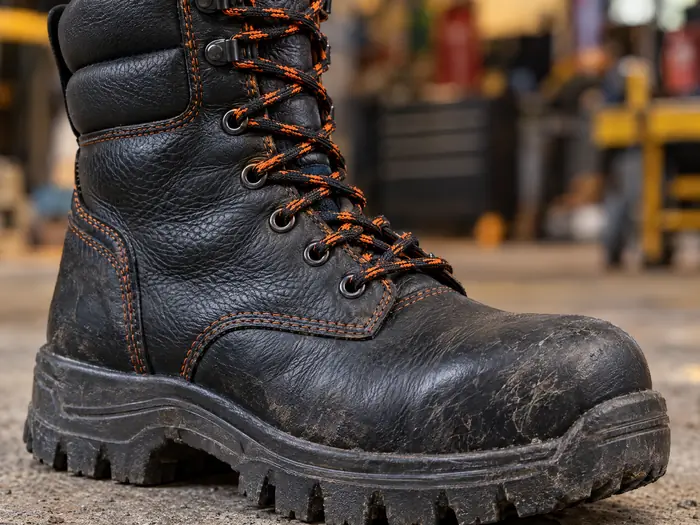
The garment is the middle of the chain; the footwear is the end that touches the ground. Several overlapping resistance ranges are used for footwear, and antistatic and ESD are the two that get mixed up most often on site.
Antistatic performance is mandatory in every safety footwear category from S1 to S7, and likewise in P1–P7 protective and O1–O7 occupational footwear. That is why the A symbol is not printed separately on those shoes. Footwear that meets only the basic requirements, SB, PB or OB, is not tested for antistatic performance.
The ranges overlap without being the same, and the test methods differ too. An S3 shoe measuring 500 MΩ in the laboratory is antistatic under EN ISO 20345, yet it sits at five times the 100 MΩ ESD limit. The reverse also happens: an ESD shoe that drops below 100 kΩ no longer meets the antistatic lower limit for safety footwear. That lower limit is there to give limited protection against a dangerous shock when working at up to 250 V. Where one site has both an explosive area and an electronics line, the shoe to look for carries both markings; such shoes fall between 100 kΩ and 100 MΩ and, according to DGUV, generally meet the TRGS 727 requirement as well.
Two numbers circulate for the ESD upper limit. DGUV Regel 112-191 gives 100 MΩ, based on IEC 61340-5-1; an older edition of the standard set it at 35 MΩ, and many footwear manufacturers still recommend that value. Writing the one you want into the specification settles the argument before delivery rather than after.
| Type | Basis | Resistance range | Purpose |
|---|---|---|---|
| Partially conductive (C) | EN ISO 20345:2022 | ≤ 100 kΩ (10⁵ Ω) | Handling explosives; not used where live parts are a risk |
| Antistatic (A) | EN ISO 20345:2022 | > 100 kΩ – ≤ 1000 MΩ (10⁵–10⁹ Ω) | Draining charge from the wearer; mandatory in S1–S7 |
| ESD | IEC 61340-5-1; tested to EN IEC 61340-4-3 | ≤ 100 MΩ (10⁸ Ω); 35 MΩ in an older edition | Protecting components in an EPA |
| Antistatic + ESD | Both markings | > 100 kΩ – ≤ 100 MΩ | Wearer and component together; in line with the 10⁸ Ω TRGS 727 target |
| Electrically insulating | EN 50321-1 | Lower limit 1000 MΩ (10⁹ Ω) | Live working; does not drain static charge |
Flame-retardant and antistatic in one garment
EN 1149-5 is about preventing the spark. It has nothing to say about what happens if ignition occurs anyway. The second hazard in an explosive atmosphere, flame and heat, is the subject of EN ISO 11612, the standard for clothing that protects against heat and flame. That is why refineries, gas distribution networks and chemical plants ask for both properties in a single fabric.
In a multi-norm fabric a small share of conductive fibre is woven in among the flame-retardant base fibres. The two performances are tested separately and the label carries both pictograms. When reading the report, check whether the heat tests and the electrostatic test were run on washed samples; a result from new fabric says little about the garment a few months into service.
The layering rule applies twice here. For static, the outer garment has to cover any non-conforming layer beneath it during every movement. For flame, the layer underneath matters as well: a synthetic base layer that melts in a flash or an arc can reduce the protection the flame-retardant outer fabric provides.
Wearing a separate antistatic vest over a flame-retardant jacket does not meet this need: the vest leaves the jacket sleeves uncovered and, unless it is flame-retardant itself, becomes the weakest layer in a flash fire. Both properties belong in the same outermost layer.
Laundering, softener and periodic resistance checks
The warning in manufacturers' user information is direct: antistatic performance can change with wear, laundering and contamination. Conductive fibre woven into the fabric does not simply wash out, but over time it can wear, break, or end up coated with dirt and chemical residue.
Fabric softener deserves its own paragraph. Softeners and similar topical antistats can alter how a fabric behaves electrostatically, but the EOS/ESD Association describes the effect of topical antistats as temporary. Washing a garment with conductive fibre in softener can make readings look better than they really are for a while, or coat the conductive fibre and lower its conductivity. For garments sent to an industrial laundry, get written confirmation that the care label instructions, including any ban on softener, are followed.
Footwear changes faster. According to DGUV Regel 112-191, flexing, dirt, temperature and moisture can shift resistance considerably, and Class I footwear such as leather can turn conductive when worn for long periods in wet conditions. Where needed, the rule calls for an on-site resistance test carried out at regular intervals. A shoe whose sole has picked up something that raises resistance, in a paint booth for example, is checked before every entry into the hazardous area. In ESD areas, test stations are used for the daily footwear check.
For garments, no standard fixes the interval. EN IEC 61340-5-1:2024 refers to IEC 61340-5-4 for compliance verification testing, and the site's own verification plan sets the frequency. For clothing used in explosive atmospheres, measurement and replacement criteria come from the risk assessment and the manufacturer's instructions. Logging every measurement with the date, the garment number and the result is the practical way to show an auditor what was checked and when.
What to put in the specification and the quote request
The most common gap in antistatic and ESD clothing requests is a two-word description: “antistatic coverall”. When you ask Formasan for a quote, giving the details below in one message lets the first fabric and pattern proposal land in the right place.
- Where it will be worn: the explosive atmosphere zone (for example zone 1 or 22) or the EPA. If both are in the same building, list the two areas separately.
- Standards required: EN 1149-5:2018; EN ISO 11612 and the codes needed if there is a flame hazard; EN 61340-5-1 for ESD and whether the garment must be groundable.
- Documents: the EN 1149-1 or EN 1149-3 test report for the fabric, the EN 61340-4-9 measurement for ESD garments, user information in Turkish or the language of the site.
- Laundering: home or industrial laundry, and the chemicals the laundry uses.
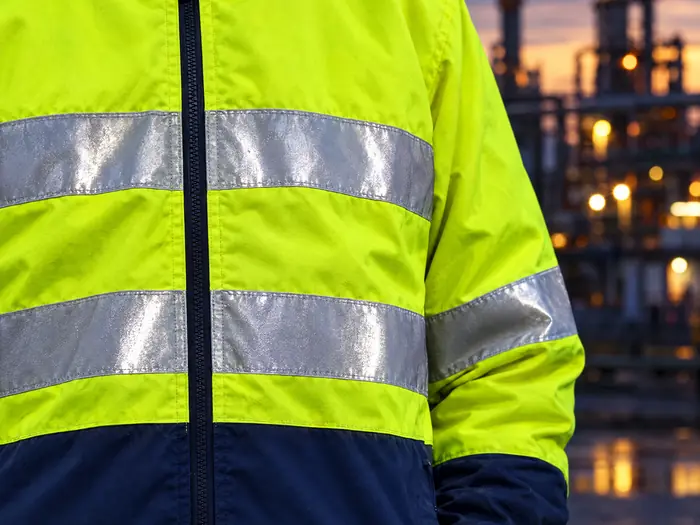
- Logos, badges and reflective tape: position, size and material. Anything added to the outer surface is chosen so that the garment still meets EN 1149-5.
- Footwear, if it is to be supplied as well: A, ESD or both; for ESD, 35 MΩ or 100 MΩ.
Standards and regulations referenced
- EN 1149-5:2018
- EN 1149-1:2006
- EN 1149-2
- EN 1149-3:2004
- EN ISO 13688:2013
- EN 60079-32-2:2015
- CEN/CLC/TR 16832:2015
- EN IEC 61340-5-1:2024
- EN IEC 61340-4-9:2024
- EN IEC 61340-4-3
- IEC 61340-5-4
- ANSI/ESD S20.20
- EN ISO 20345:2022
- EN 50321-1
- EN ISO 11612
- Directive 1999/92/EC
- Regulation (EU) 2016/425
- Çalışanların Patlayıcı Ortamların Tehlikelerinden Korunması Hakkında Yönetmelik (RG 30.04.2013, sayı 28633)
- TRGS 727
- DGUV Regel 112-191 (Aralık 2025)