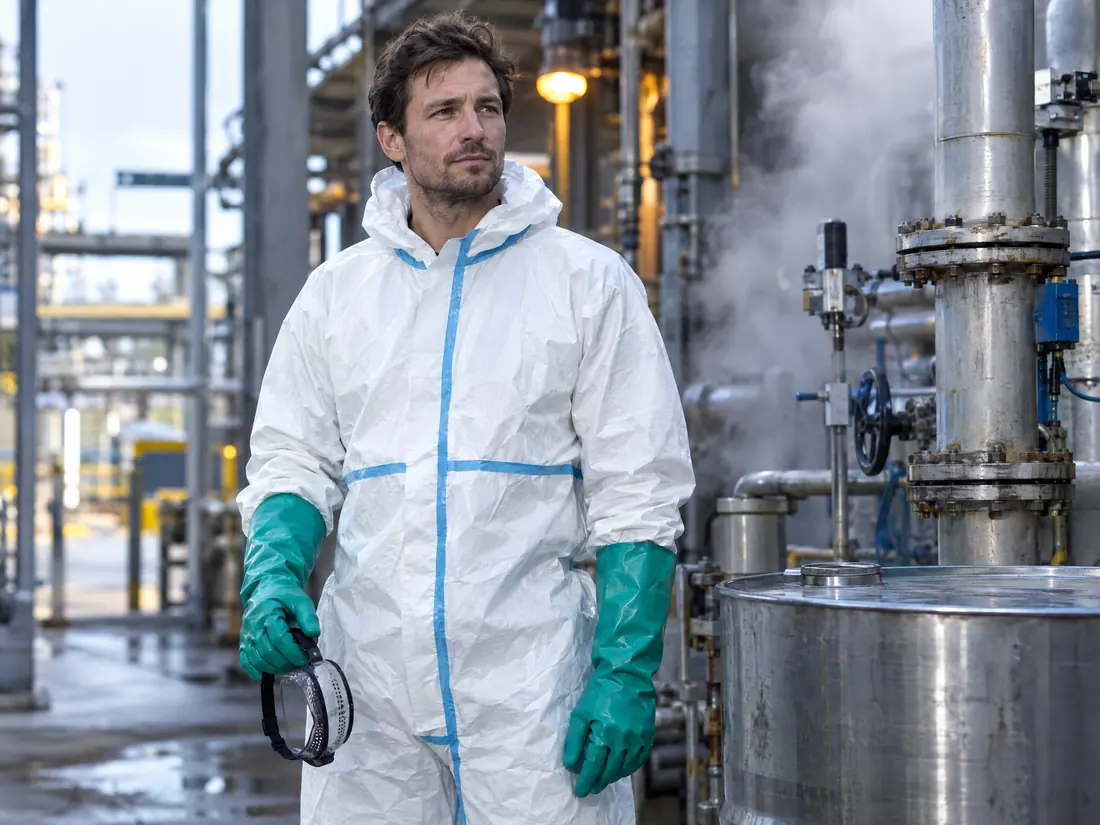
What the type number tells you
A type number describes how the complete garment behaves against one form of exposure, not how good its fabric is. The test takes in the seams, zip, hood and cuff finishes together, which is why a fabric data sheet on its own never tells you the type of the coverall made from it.
Do not read the numbers as a ladder. Types 1, 3, 4 and 6 sit on a liquid-and-gas axis, ordered by how tight the garment is; Type 5 sits on its own axis and deals only with dry particles. A Type 4 coverall that has not passed the Type 5 test is not certified against dust. Hence the multi-type labels: every number on them is a separate test report.
The material is classified separately, in EN 14325:2018, which collects test methods and performance classes for materials, seams, joins and assemblages. The jet and spray test standards say outright that they do not measure permeation through the fabric. How many minutes a solvent takes to get through is answered by the manufacturer's chemical list and the safety data sheet, not by the type number.
Matching starts in section 8 of the safety data sheet, headed exposure controls/personal protection. There the supplier has to state the type and quality of protective equipment needed for the body, and for gloves the material, its thickness and the breakthrough time.
US readers will know Levels A to D from OSHA 29 CFR 1910.120, Appendix B. Those levels bundle clothing with respiratory protection, while European types classify the garment alone, so the two systems do not map one to one.
Type 1 to Type 6: standards and whole-suit tests
The table at the end of this section gives each standard in its edition currently harmonised under the PPE Regulation (European Commission summary list, September 2026) and the whole-suit test behind each type.
Type 1 covers ventilated and non-ventilated gas-tight suits, tested as full-body ensembles. EN 943-1 takes in the seams, joins and the way accessories are attached; gloves, boots and breathing apparatus bring their basic performance from their own standards. Total immersion, fire, heat, explosive, radiological and infective hazards are outside its scope.
Type 2 still turns up in older documents. ECDC's 2014 technical document on PPE lists it as the non-gas-tight type under EN 943-1:2002, next to gas-tight sub-types 1a, 1b and 1c that still turn up on older labels. Whatever a marking means, the instructions have to explain it. The 2015 edition covers gas-tight suits only. If a new specification asks for Type 2, rebuild it around the actual exposure; the discussion usually ends up between Type 1 and Type 3.
Types 3 and 4 differ in the connections. Type 3 needs liquid-tight joins between the garment's parts and, where fitted, to the hood, gloves, boots, visor or respirator; Type 4 needs them spray-tight. The jet test fires a pressurised stream at the suit, the spray test surrounds it with droplets. Breaking a coupling on a filling line, where acid may spurt from the hose, is a Type 3 question. Washing down a surface with the diluted product sits closer to Type 4.
Type 6 is deliberately narrow. It covers light spray, liquid aerosols and small splashes at low pressure, and the standard does not expect the garment to hold chemicals back at the molecular level. A few drops landing on the front while transferring a sample in the lab fit that description. A bucket of solution tipping over does not.
PB stands for partial body. PB [3], PB [4] and PB [6] go on garments that cover only part of the body: lab coats, aprons, jackets, trousers, sleeves and hoods. These are not put through the whole-suit test; the standards ask only for the performance of the material and the seams. A PB [6] apron is therefore no substitute for a Type 6 coverall, because whatever it does not cover stays exposed.
| Type | Protects against | Standard (current edition) | Whole-suit test | Partial body |
|---|---|---|---|---|
| Type 1 | Gases, vapours, liquid and solid chemicals; gas-tight | EN 943-1:2015+A1:2019; EN 943-2:2019 for emergency teams (ET) | Gas-tightness | None |
| Type 2 | Non-gas-tight suit | Defined in EN 943-1:2002; not in the current edition | — | None |
| Type 3 | Pressurised liquid jet; liquid-tight connections | EN 14605:2005+A1:2009 | Jet test (EN ISO 17491-3) | PB [3] |
| Type 4 | Heavy spray; spray-tight connections | EN 14605:2005+A1:2009 | High-level spray test (EN ISO 17491-4, Method B) | PB [4] |
| Type 5 | Airborne dry particles | EN ISO 13982-1:2004+A1:2010 | Inward leakage test with a fine dust aerosol (EN ISO 13982-2) | None |
| Type 6 | Light spray, liquid aerosols, low-pressure low-volume splashes | EN 13034:2005+A1:2009 | Reduced spray test (variant of EN ISO 17491-4) | PB [6] |
What a Type 5/6 coverall means, and where it is used
A Type 5/6 coverall is a full-body garment that has passed both the dry particle test of EN ISO 13982-1 and the light spray test of EN 13034. The double label answers two common risks at once: dust in the air and the occasional stray droplet.
Typical jobs: tipping powdered chemicals from sacks into a vessel, maintenance where old insulation and asbestos-containing materials are present, scraping lead paint, weighing rooms for pharmaceutical or pigment powders, dry cleaning inside tanks, and sampling with only light splashing. Municipal pest-control spraying and foam cleaning in food plants are borderline. Heavy spray brings Type 4 into the discussion, and pesticide operators have their own standard, EN ISO 27065.
Knowing where it stops matters more than knowing the number. A Type 5/6 coverall makes no claim against gases or vapours; that is Type 1 territory. Nor is it built for pressurised liquid, kneeling in liquid or leaning on a wet surface for hours. HSE's asbestos guidance notes that outdoor work may also call for waterproof overalls, and a Type 5/6 coverall soaked in the rain is not that garment.
A Type 4/5/6 label goes one step further: the coverall has also passed the high-level spray test. The type number does not spell out details such as taped or welded seams or an adhesive zip flap, and ECDC's PPE guidance says to write them into the purchase specification. The table below is only a starting point.
| Site situation | Starting type | Note |
|---|---|---|
| Emptying powdered chemicals from sacks | Type 5 (often Type 5/6) | Respiratory protection chosen separately |
| Work with asbestos-containing materials | Type 5, hooded, one size up | At least an FFP3 or P3-filtered mask (HSE); removal falls under separate regulations |
| Scraping lead paint, lead dust | Clean, sound work overalls or Type 5 | Clothing leaves site only for a specialist laundry, never goes home |
| Sampling, transfers in the lab | Type 6 or PB [6] apron and sleeves | Type 4 or Type 3 if a larger spill is possible |
| Spray washing, foam cleaning | Type 4 | EN ISO 27065 for pesticide application |
| Line breaking, risk of pressurised liquid | Type 3 | Glove and boot connections must be liquid-tight too |
| Responding to a gas or vapour release | Type 1 | Worn with breathing apparatus; EN 943-2 for emergency teams |
Asbestos and lead dust: coveralls with FFP3
With asbestos, the coverall type is settled. The UK's Health and Safety Executive rates disposable Type 5 overalls (EN ISO 13982-1) as suitable both in its EM6 sheet for non-licensed work and in L143, the approved code of practice for the Control of Asbestos Regulations 2012. What deserves attention is how the coverall is worn.
HSE says to buy one size up so the seams do not split when bending and reaching. Cuffs, ankles and hood should be elasticated, with no pockets to trap dust. Legs go over the boots, not tucked in, or dust is funnelled into the footwear. The hood goes over the respirator straps; loose cuffs get taped. Laced boots are out, because fibres lodge between the laces and are very hard to clean off, and HSE prefers laceless boots to disposable overshoes, which can cause slips.
For the face, HSE asks for an assigned protection factor of at least 20: a disposable FFP3 respirator to EN 149, or a half mask with a P3 filter. Neither works over a beard or stubble, and long continuous work needs powered equipment. At the end of the shift the respirator comes off last, after the coverall.
In Turkey, asbestos removal is governed by the Regulation on Health and Safety Measures in Work with Asbestos: removal workers operate under an asbestos removal specialist, and the job is notified with a work plan before it starts. Article 14 deals with clothing directly. PPE does not leave the workplace, protective clothing is cleaned on site or where the cleaning is done and leaves only in closed containers, and work clothes are stored apart from workers' own, at no cost to them.
Lead works differently. HSE's lead code, L132, accepts that in many workplaces ordinary overalls are enough, provided they are clean and in good repair. The real requirement is that clothing must not carry lead around: it should not collect and trap dust, at least two sets are issued (one worn, one in the wash), and contaminated clothing leaves the premises only for a specialist laundry, never home. For heavy-dust jobs such as dry sanding, or where no controlled laundry chain exists, disposable Type 5 coveralls make life simpler.
In Turkey, health surveillance and blood lead testing for lead work are set out in Annex 2 of the Regulation on Health and Safety Measures in Work with Chemical Substances. The coverall does not replace that surveillance. What it does is stop lead travelling home.
Extra markings: B, ET, EN 1073-2 and EN 1149-5
The small additions next to a type number each stand for a separate test. The table at the end collects the common ones.
B is for biological. According to ECDC, a B after the type number shows the material is also certified against various biological contaminants, so a Type 5-B fabric has passed both the particle test and the EN 14126 tests. A key one is ISO 16604, which measures resistance to blood-borne pathogens using a bacteriophage. ECDC treats Type 3-B material as an effective barrier against aerosols and against tiny particles like viruses or spores. Surgical team clothing is outside EN 14126.
EN 1073-2 covers non-ventilated clothing against particulate radioactive contamination. The garment protects the body, arms and legs, while boots, gloves and respiratory protection come under their own standards. Its subject is radioactive dust settling on skin and clothing; shielding against the radiation itself is not part of its scope.
EN 1149-5:2018 covers the material and design of electrostatic dissipative clothing. It treats the garment as part of a totally earthed system, with people and other conductors earthed through less than 10⁸ Ω, in explosive atmospheres whose minimum ignition energy is at least 0.016 mJ. It may fall short in oxygen-enriched atmospheres and does not protect against mains voltage. An antistatic coverall worn with insulating footwear has nowhere to send its charge, so in classified areas the coverall, footwear and floor are chosen together.
| Marking | Standard | What it tells you | Watch out for |
|---|---|---|---|
| Type 5-B, 6-B etc. | EN 14126:2003 | The material has also been tested against infective agents | Does not define taped seams, a fixed hood or a zip flap |
| PB [3], PB [4], PB [6] | EN 14605, EN 13034 | Garment covering part of the body (apron, sleeves, lab coat) | Not whole-suit tested; no substitute for a coverall |
| ET | EN 943-2:2019 | Gas-tight Type 1 suit for emergency teams | Type 1 only |
| EN 1073-2 | EN 1073-2:2002 | Non-ventilated clothing against radioactive particulate contamination | Prevents contamination; it is not radiation shielding |
| EN 1149-5 | EN 1149-5:2018 | Clothing that dissipates static charge | Works only on an earthed wearer; may fall short in oxygen-enriched atmospheres |
Let's choose the right product for your team
Tell us the site conditions, quantity and the standard you need; we come back with fabric, model and sample options.
Disposable or reusable?
EN 13034 and EN 14605 cover both limited-use (disposable) and reusable garments. Which one fits the job depends on the substance, how heavily the garment gets contaminated and whether it can be decontaminated safely.
The word disposable is not a protection claim. Some disposable coveralls are sold simply to keep paint and dirt off and carry no chemical type number at all. Under the EU PPE Regulation, Category I covers minimal risks only, such as superficial mechanical injury or contact with cleaning materials of weak action. If the pack shows no type number and no four-digit notified body number beside the CE mark, the coverall is not for chemicals or asbestos.
A disposable coverall lasts one shift, less if it gets contaminated. For asbestos, HSE expects disposable overalls in most cases to go out as asbestos waste after every shift; occasional sampling with a low risk of contamination is the exception it names. Hanging a used coverall on a hook for tomorrow is the quickest way to move a dirty outside onto a clean inside. Shelf life matters too: the EU PPE Regulation asks for the obsolescence date or period, where applicable, in the instructions. Check old cartons in the store.
Reusable garments need decontamination, inspection and a record after every use: look for blistering, stiffening or a tacky surface, scratches and zip damage. Turkey's Regulation on the Use of PPE at Workplaces requires maintenance and periodic checks to follow the manufacturer's instructions, PPE to be free of charge, and the period of use to reflect the risk, the frequency of exposure and the equipment's performance. Reusable clothing contaminated with asbestos or lead goes to a specialist laundry, for asbestos in hot-water-soluble bags loaded unopened.
Category III and CE: what the label should show
Regulation (EU) 2016/425 lists substances and mixtures hazardous to health, harmful biological agents and ionising radiation among Category III risks, the ones that can cause very serious consequences such as death or irreversible damage to health. That puts every chemical protective coverall, a disposable Type 5/6 included, in the top category. Turkey applies the same scheme through its PPE Regulation aligned with 2016/425 (Official Gazette, 1 May 2019, No. 30761).
A Category III product passes two stages before reaching the market. A notified body first carries out the EU type-examination (Module B). Production is then monitored either by supervised product checks at random intervals (Module C2) or by quality assurance of the production process (Module D). The number of the body involved in that second stage sits beside the CE mark. A pictogram for the risk may follow; the EU Regulation leaves it optional, while the Turkish regulation requires it. A bare CE with no number on a chemical coverall is an incomplete label.
The rest of the label falls under EN ISO 13688, the general standard for ergonomics, innocuousness, size designation, ageing, compatibility, marking and manufacturer's information. It is only ever applied alongside a performance standard. The instructions should cover putting on, use, cleaning, storage and disposal. On the employer's side, Turkey's regulation on PPE use at work requires equipment in use to carry the CE mark and come with instructions in Turkish.
Where several items are worn together, the same regulation requires them to be compatible, so that one does not undermine the protection of another. The coverall hood should not ride over the respirator's sealing edge, and a goggle strap should not drag the hood upwards. A trial fitting before purchase is where such clashes show up.
Putting on, taping and taking off
Before starting, check the coverall for size and damage, and take off watches and rings that could tear it. Step in and pull the legs down over the boots. Fit the respirator and do a fit check, bring the hood over its straps, close the zip and seal the flap. Gloves go on last. ECDC suggests a simple test: in full kit, kneel and raise your arms. If the waist, wrists or neck open up, the size is wrong.
Tape makes coverall and glove or boot behave as one piece. HSE recommends taping loose cuffs for asbestos work; ECDC weighs the pros and cons. Done well, tape lets gloves and boots come off with the coverall in one movement. Done badly, it tears during removal, or sits so tight on the forearm that the hand cannot get out of the glove; the band of tape has to be wider than the widest part of the hand. Tape does not fix a wrong size, and taping a coverall tighter lowers protection. Fabric-backed duct tape wicks liquid, so use good parcel tape or chemical-resistant tape, and check what the manufacturer's instructions say about taping.
Heat is a risk of its own. HSE's asbestos code treats work in hot and humid conditions as something to avoid wherever possible; where it cannot be avoided, it asks for cooler working times, shorter work periods and measures against dehydration. A worker sweating in coverall and mask will loosen the hood or drop the mask, so the shift plan is as much part of the protection as the coverall.
Removal is when contamination travels most easily. ECDC recommends working in pairs, one person undressing while the other watches and helps. The sequence below follows HSE's asbestos sheet EM8 for the most part and makes a good skeleton for chemical work as well:
- Wipe the boots with a damp rag at the exit of the work area.
- Clean dust off the coverall with the brush attachment of a Class H vacuum, or with a damp rag used in a patting motion; rubbing lifts fibres into the air.
- Leave the tape on taped gloves and boots and take them off together with the coverall.
- Peel the coverall off inside out without touching the outer surface and put it straight into a waste bag.
- Take the respirator off last; a disposable one goes into the same bag.
- Seal the bag, then wash hands and face, and shower after dusty work.
Materials, and what to specify when ordering
Type 5/6 coveralls are usually made from nonwovens, and two families come up most often. SMS places a meltblown layer between two spunbond layers. As the European nonwovens association EDANA explains, drawing the filaments in the spunlaid process gives the fabric its strength, while meltblown filaments are drawn out by hot air into far finer fibres, down to about one micron, with low tensile strength. Strength outside, fine fibres in the middle: that is SMS. Porous by design, it breathes well, but its liquid barrier is limited next to filmed fabrics.
Microporous film laminate bonds a thin plastic film full of micro-pores onto a nonwoven backing. The film stops liquid droplets and dust, while the pores let part of the water vapour escape. As a general rule, film is tighter against liquid and SMS is more comfortable in warm conditions. A firm comparison comes only from the test reports of the actual products.
In Types 3 and 4 the fabric is usually a coated material or a multi-layer laminate. There the choice is decided not by the material's name but by the permeation data given for the substance you actually use.
Before a bulk order, get samples in two or three sizes and have the crew wear them for a shift; that shows what a catalogue cannot, such as how the hood sits with the mask, sleeve length and sweating. When asking Formasan for a quote, paste the list below into the quote form. With all of it in one message, the right coverall can be settled in one round:
- Type or type combination (for example Type 5/6 or Type 4/5/6) and, if needed, the B, EN 1073-2 or EN 1149-5 marking
- Names of the substances in use and their safety data sheets
- Details such as hood, attached socks, thumb loops, zip flap and seam type
- Size breakdown and number of people per shift
- Estimated quantity per month or per job; for disposables, the shelf life you expect
- The respirators, gloves and boots that will be worn with it
Standards and regulations referenced
- EN 943-1:2015+A1:2019
- EN 943-2:2019
- EN 14605:2005+A1:2009
- EN 13034:2005+A1:2009
- EN ISO 13982-1:2004+A1:2010
- EN ISO 13982-2:2004
- EN ISO 17491-3:2008
- EN ISO 17491-4
- EN 14325:2018
- EN 14126:2003
- ISO 16604
- EN 1073-2:2002
- EN 1149-5:2018
- EN ISO 13688:2013+A1:2021
- EN ISO 27065:2017+A1:2019
- Regulation (EU) 2016/425
- Commission Implementing Decision (EU) 2026/1279 (repealing 2023/941)
- European Commission summary list of harmonised standards under Regulation (EU) 2016/425 (4 September 2026)
- Commission Regulation (EU) 2020/878 (REACH Annex II, SDS section 8)
- OSHA 29 CFR 1910.120 Appendix B
- ECDC Safe use of PPE in the treatment of infectious diseases of high consequence (2014)
- HSE Asbestos essentials EM6 and EM8 (2017)
- HSE L143 Managing and working with asbestos (2013)
- HSE L132 Control of lead at work (2002)
- Kişisel Koruyucu Donanım Yönetmeliği (RG 01.05.2019, 30761)
- Kişisel Koruyucu Donanımların İşyerlerinde Kullanılması Hakkında Yönetmelik (RG 02.07.2013, 28695)
- Asbestle Çalışmalarda Sağlık ve Güvenlik Önlemleri Hakkında Yönetmelik (RG 25.01.2013, 28539)
- Kimyasal Maddelerle Çalışmalarda Sağlık ve Güvenlik Önlemleri Hakkında Yönetmelik (RG 12.08.2013, 28733)